


On this weblog, we’ll dive into how massive language fashions, generative AI, and the Triangle System assist us leverage automation and suggestions loops for extra environment friendly incident administration.
Excessive service high quality is essential to the reliability of the Azure platform and its a whole bunch of providers. Constantly monitoring the platform service well being permits our groups to promptly detect and mitigate incidents which will affect our clients. Along with automated triggers in our system that react when thresholds are breached and customer-report incidents, we make use of Synthetic Intelligence-based Operations (AIOps) to detect anomalies. Incident administration is a fancy course of, and it may be a problem to handle the size of Azure, and the groups concerned to resolve an incident effectively and successfully with the wealthy area data wanted. I’ve requested our Azure Core Insights Crew to share how they make use of the Triangle System utilizing AIOps to drive faster time to decision to in the end profit consumer expertise.
—Mark Russinovich, Azure CTO at Microsoft
Optimizing incident administration
Incidents are managed by designated accountable people (DRIs) who’re tasked with investigating incoming incidents to handle how and who must resolve the incident. As our product portfolio expands, this course of turns into more and more advanced because the incident logged in opposition to a selected service is probably not the basis trigger and will stem from any variety of dependent providers. With a whole bunch of providers in Azure, it’s practically unimaginable for anyone particular person to have area data in each space. This presents a problem to the effectivity of handbook analysis, leading to redundant assignments and prolonged Time to Mitigate (TTM). On this weblog, we’ll dive into how massive language fashions, generative AI, and the Triangle System assist us leverage automation and suggestions loops for extra environment friendly incident administration.
AI brokers have gotten extra mature as a result of bettering reasoning means of huge language fashions (LLMs), enabling them to articulate all of the steps concerned of their thought processes. Historically, LLMs have been used for generative duties like summarization with out leveraging their reasoning capabilities for real-world decision-making. We noticed a use case for this functionality and constructed AI brokers to make the preliminary project selections for incidents, saving time and decreasing redundancy. These brokers use LLMs as their mind, permitting them to assume, cause, and make the most of instruments to carry out actions independently. With higher reasoning fashions, AI brokers can now plan extra successfully, overcoming earlier limitations of their means to “assume” comprehensively. This strategy won’t solely enhance effectivity but in addition improve the general consumer expertise by guaranteeing faster decision of incidents.
Introducing the Triangle System
The Triangle System is a framework that employs AI brokers to triage incidents. Every AI agent represents the engineers of a selected staff and is encoded with area data of the staff to triage points. It has two superior features: Native Triage and World Triage.
Native Triage System
The Native Triage System is a single agent framework that makes use of a single agent to characterize every staff. These single brokers present a binary resolution to both settle for or reject an incoming incident on behalf of its staff, primarily based on historic incidents and current troubleshooting guides (TSGs). TSGs are a set of pointers that engineers doc to troubleshoot widespread patterns of points. These TSGs are used to coach the agent to simply accept or reject incidents and supply the reasoning behind the choice. Moreover, the agent can suggest the staff to which the incident must be transferred to, primarily based on the TSGs.
As proven in Determine 1, the Native Triage system begins when an incident enters a service staff’s incident queue. Based mostly on the coaching from historic incidents and TSGs, the one agent employs Generative Pretrained Transformer (GPT) embeddings to seize the semantic meanings of phrases and sentences. Semantic distillation entails extracting semantic data from the incident that’s carefully associated to incident being triaged. The one agent will then determine to simply accept or reject the incident. If accepted, the agent will present the reasoning, and the incident shall be handed off to an engineer to evaluation. If rejected, the agent will both ship it again to the earlier staff, switch to a staff indicated by the TSG, or preserve it within the queue for an engineer to resolve.
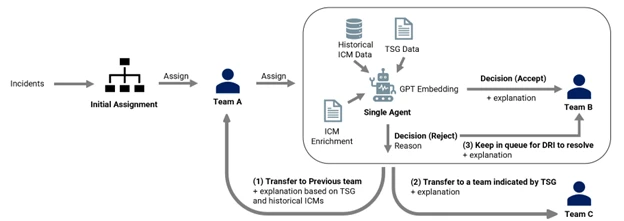
Determine 1: Native Triage system workflow
The Native Triage system has been in manufacturing in Azure since mid-2024. As of Jan 2025, 6 groups are in manufacturing with over 15 groups within the strategy of onboarding. The preliminary outcomes are promising, with brokers reaching 90% accuracy and one staff noticed a discount of their TTM of 38%, considerably decreasing the affect to clients.
World Triage System
The World Triage System goals to route the incident to the proper staff. The system coordinates throughout all the one brokers through a multi-agent orchestrator to establish the staff that the incident must be routed to. As proven in Determine 2, the multi agent orchestrator selects appropriate staff candidates for the incoming incident, negotiates with every agent to seek out the proper staff, additional decreasing TTM. This can be a related strategy to sufferers coming into the emergency room, the place the nurse briefly assesses signs and directs every affected person to their specialist. As we additional develop the World Triage System, brokers will proceed to develop their data and enhance their decision-making talents, vastly bettering not solely the consumer expertise by mitigating buyer points rapidly but in addition bettering developer productiveness by decreasing handbook toil.
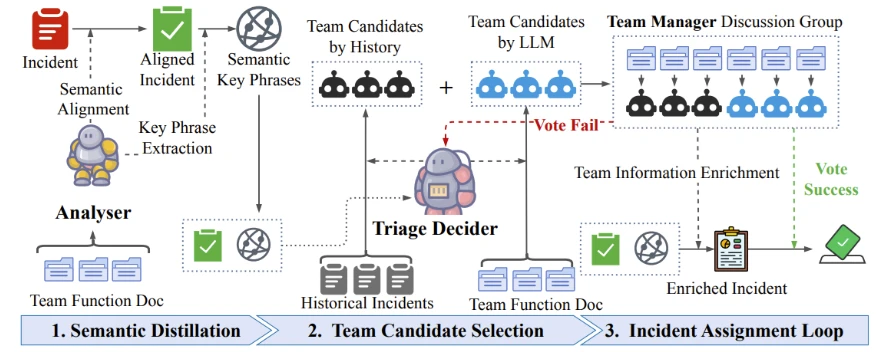
Determine 2: World Triage system workflow
Wanting ahead
We plan to develop protection by including extra brokers from totally different groups that may broaden the data base to enhance the system. A few of the methods we plan to do that embody:
- Prolong the incident triage system to work for all groups: By extending the system to all groups, we purpose to boost the general data of the system enabling it to deal with a variety of points. Making a unified strategy to incident administration would result in extra environment friendly and constant dealing with of incidents.
- Optimize the LLMs to swiftly establish and suggest options by correlating error logs with the precise code segments liable for the problem: Optimizing LLMs to rapidly establish, correlate, and suggest options will considerably pace up the troubleshooting course of. It permits the system to offer exact suggestions, decreasing the time engineers spend on debugging and resulting in sooner decision of points for patrons.
- Broaden auto mitigating recognized points: Implementing an automatic system to mitigate recognized points will scale back TTM bettering buyer expertise. This can even scale back the variety of incidents that require handbook intervention, enabling engineers to give attention to delighting clients.
We first launched AIOps as a part of this weblog collection in February 2020 the place we highlighted how integrating AI into Azure’s cloud platform and DevOps processes enhances service high quality, resilience, and effectivity by key options together with {hardware} failure prediction, pre-provisioning providers, and AI-based incident administration. AIOps continues to play a essential function at this time to foretell, defend, and mitigate failures and impacts to the Azure platform and enhance buyer expertise.
By automating these processes, our groups are empowered to rapidly establish and handle points, guaranteeing a high-quality service expertise for our clients. Organizations seeking to improve their very own service reliability and developer productiveness can accomplish that by integrating AI brokers into their incident administration processes designed within the Triangle System. Learn the Triangle: Empowering Incident Triage with Multi-LLM-Brokers paper from Microsoft Analysis.
Thanks to the Azure Core Insights and M365 Crew for his or her contributions to this weblog: Alison Yao, Knowledge Scientist; Madhura Vaidya, Software program Engineer; Chrysmine Wong, Technical Program Supervisor; Ze Li, Principal Knowledge Scientist Supervisor; Sarvani Sathish Kumar, Principal Technical Program Supervisor; Murali Chintalapati, Companion Group Software program Engineering Supervisor; Minghua Ma, Senior Researcher; and Chetan Bansal, Sr Principal Analysis Supervisor.