
Cybersecurity leaders are at a crossroads: AI- and cloud-driven dangers shift in a matter of days or even weeks, demanding specialised, instantly accessible experience. But too many organizations proceed to rent safety expertise as if threats nonetheless observe regular, forecastable patterns. For years, the largest impediment to retaining organizations protected was a common scarcity of certified safety professionals. Now, the core subject is outdated workforce fashions constructed for a predictability that now not exists.
Latest knowledge highlights this disconnect. The annual ISC2 Cybersecurity Workforce Research didn’t embrace its normal world headcount hole estimate in its 2025 report, as a result of expertise shortages have overtaken staffing numbers because the dominant subject for its 16,000 survey respondents. Greater than half of them reported important or vital talent gaps on their in-house groups, a 34% enhance from the prior yr. And 88% join these gaps to important penalties reminiscent of gradual incident response and undersecured programs. A scarcity of IT safety expertise was additionally famous as considered one of the highest three main causes of breaches in a 2025 survey of world IT and cybersecurity decision-makers by Fortinet.
The true hole, in different phrases, is just not about workers. It’s about ready-to-deploy specialised capabilities demanded by in the present day’s threat panorama. Latest hiring patterns mirror this shift: Toptal’s Q1 2026 Excessive-skilled Job Report discovered that employers are pulling again from broad-based generalist safety hires in favor of bringing on skilled specialists who can ship quick impression. Hiring is turning into extra selective, extra senior, and extra versatile in construction, mirroring how cybersecurity threat surfaces erratically and calls for precision relatively than scale.
Within the sections that observe, we look at why legacy hiring fashions fall quick, how elastic and globally distributed expertise can fill the hole, and what it takes to use versatile, skills-based workforce fashions responsibly as AI and specialization reshape safety work.
Why the Ability Hole Persists: Static Hiring in a Dynamic Threat Surroundings
Legacy hiring fashions, designed for a extra predictable period, are essentially out of sync with in the present day’s cybersecurity calls for. They power organizations to depend on gradual, inflexible processes in a area the place dangers shift quickly and require exact, specialised capabilities.
Hiring Cycles Lag Behind Risk Velocity
Conventional recruitment follows an extended, sequential path: budgeting, inner alignment, function definition, interviews, presents, and onboarding. Even when every thing goes easily, the quickest hiring cycles not often conclude in underneath three months. In Kaspersky’s 2024 report, The Portrait of Fashionable Info Safety Skilled, almost half of knowledge safety professionals mentioned it took greater than six months to fill a cybersecurity emptiness, with senior roles regularly requiring 9 months or longer.
Cyber threat operates on a wholly completely different timeline. Vulnerabilities emerge out of the blue and are sometimes exploited virtually instantly. VulnCheck’s 2025 State of Exploitation reveals the common time to take advantage of shrinking from weeks or months in earlier menace cycles to a matter of days in the present day. In accordance with the report, round 30% of vulnerabilities are exploited by unhealthy actors earlier than organizations even know the place to search for them.
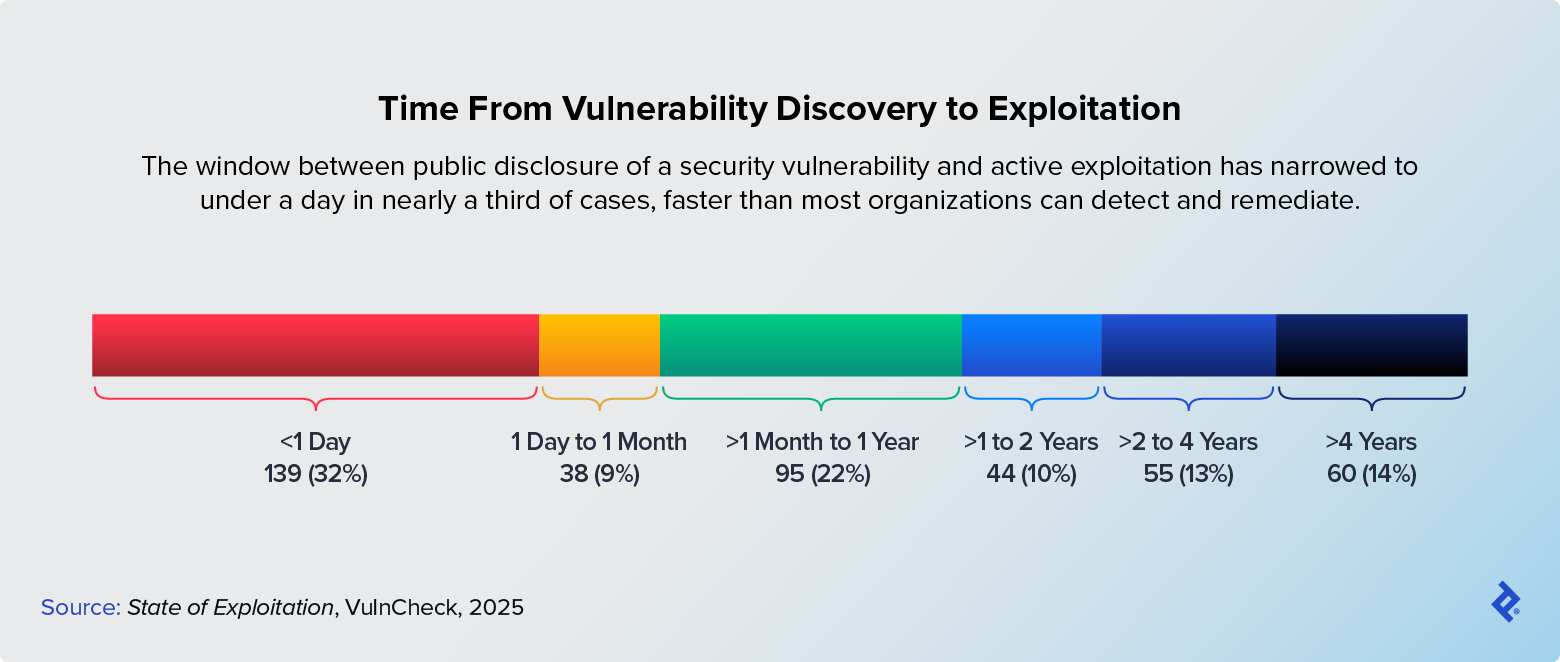
In our work with retail and client organizations, we see this timing hole present up as a recurring operational failure. Safety staffing selections are nonetheless made on quarterly or annual planning cycles, whereas the circumstances that create threat typically shift in days. Modifications in buyer habits, cost flows, supply-chain integrations, or market publicity introduce new assault surfaces lengthy earlier than a job will be accredited, employed, and onboarded.
By the point further capability arrives, groups are regularly addressing a unique drawback than the one which triggered the rent. The result’s a persistent lag between the place threat emerges and the place experience is on the market, leaving safety leaders in a steady state of catch-up relatively than management.
Specialization Has Outpaced Job Descriptions
Fashionable cybersecurity now not matches a generalist mould. Required experience has fragmented into distinct domains, every with its personal tooling, menace fashions, and operational context. On-premises safety, for instance, differs essentially from cloud-native environments. Compliance-driven work is just not the identical as software safety. AI-related dangers require hybrid expertise that mix conventional controls with mannequin auditing and adversarial defenses.
In regulated industries reminiscent of healthcare and life sciences, this fragmentation turns into particularly seen. Safety groups are sometimes staffed to fulfill audits relatively than to mirror how threat truly materializes. That’s a significant distinction: Compliance frameworks present mandatory construction, however they don’t map cleanly to fashionable knowledge flows, cloud architectures, or the best way individuals truly work. As programs migrate to hyperscale platforms, groups accustomed to securing on-premises environments are out of the blue chargeable for identification, networking, and monitoring fashions that sit outdoors their direct management. Experience that works reliably in a single surroundings doesn’t robotically translate to the opposite, creating protection gaps that compliance-driven job descriptions not often anticipate.
Brief Threat Home windows Drive Lengthy-term Safety Impression
Cybersecurity failures are not often pushed by novel or subtle assaults. Rather more typically, they consequence from delays in addressing recognized exposures throughout quick, high-risk home windows when the fitting experience is just not instantly accessible.
Proof from latest breach and value analyses reinforces this sample. Verizon’s newest breach evaluation, protecting greater than 22,000 safety incidents and over 12,000 confirmed breaches, reveals that exploitation of vulnerabilities now accounts for roughly 20% of preliminary entry vectors, a 34% year-over-year enhance. These breaches overwhelmingly contain recognized flaws in edge gadgets, VPNs, and misconfigured programs relatively than undisclosed vulnerabilities. Median patching occasions stay round 32 days, creating a large hole between publicity and remediation.
The monetary results of those delays are effectively documented. IBM’s Price of a Information Breach analysis constantly reveals that longer detection and containment occasions drive materially increased losses. In 2025, the common breach value reached $4.44 million, with breaches taking longer than 200 days to resolve including over $1 million in incremental prices. These will increase are regularly tied to unpatched programs and incomplete response capabilities, not a lack of information.
Taken collectively, these findings spotlight a constant actuality:
- Essentially the most damaging breaches exploit recognized, addressable weaknesses.
- Threat escalates throughout quick, high-intensity intervals.
- Timing, not novelty, determines each operational and monetary impression.
In consumer-facing environments, for instance, the implications of this sample prolong effectively past technical threat. Safety outcomes are measured as a lot by what doesn’t occur as by what does. A single incident can dominate headlines, erode buyer belief, and draw govt and board consideration away from progress initiatives. Consequently, safety groups are sometimes pulled right into a defensive posture, prioritizing harm containment over enablement.
When specialised experience can’t be mobilized shortly, product launches gradual, integrations are deferred, and enterprise groups study to route round safety as a substitute of working with it. Over time, safety turns into perceived as a constraint on supply, even when the underlying subject is capability arriving too late.
AI Is Reshaping Safety Sooner Than Workforce Fashions Can Adapt
AI is accelerating cybersecurity operations whereas concurrently rising the complexity of the dangers groups should handle. Detection and response have gotten sooner and extra automated, however the expertise required to control and safe AI-enabled programs are evolving sooner than conventional workforce fashions can alter.
In lots of environments, AI reduces guide effort in early-stage safety work, bettering alert triage, sample detection, and operational effectivity. As routine duties develop into automated, human effort shifts towards oversight, validation, and threat judgment relatively than execution.
On the similar time, AI introduces publicity areas that fall outdoors conventional safety domains, together with mannequin integrity, knowledge governance, and dangers tied to third-party AI providers. Addressing these challenges requires hybrid experience spanning safety engineering, knowledge science, and platform structure, profiles that stay scarce and tough to develop internally on quick timelines.
Business knowledge displays this pressure. ISC2 identifies AI-related safety expertise among the many most urgent workforce gaps, whereas Fortinet reviews that candidates with particular cybersecurity AI expertise are the second-most tough to recruit, with 57% of organizations citing this problem. Hiring habits is already shifting in response: Toptal’s Excessive-skilled Job Report for Q1 2026 notes that the safety market is shifting from resilience planning to execution, with demand concentrating on senior practitioners who can combine identification safety, governance, and AI-driven operations into stay environments.
Like different fashionable cybersecurity dangers, AI-related demand emerges erratically, concentrating round deployments, integrations, and governance critiques relatively than regular operational wants. This sample additional exposes the bounds of static hiring fashions constructed for predictable staffing demand.
Designing Your Optimum, Elastic Safety Workforce
In our work with safety leaders throughout client, healthcare, and expertise organizations, we see that efficient workforce design requires working on twin timelines. Whereas everlasting roles transfer by means of typical approval and hiring cycles, leaders additionally activate on-demand specialists to handle quick publicity tied to migrations, launch cycles, regulatory deadlines, or different time-sensitive initiatives. That is the core-and-surge mannequin: a secure inner crew augmented by focused experience as concentrated threat calls for it.
Over time, this elastic sample improves hiring selections. Leaders acquire visibility into which capabilities require steady possession and which seem solely throughout concentrated intervals of threat. Staffing evolves alongside altering enterprise circumstances as a substitute of remaining tied to assumptions made months earlier.
Efficient elastic workforce design facilities on three issues: figuring out the place functionality gaps focus, figuring out which tasks require long-term inner possession, and establishing guardrails that enable specialised experience to be deployed safely and predictably.
Step 1: Pinpoint Your Functionality Gaps
When organizations wrestle to shut cybersecurity gaps, the intuition is commonly to leap straight to hiring. However groups that make actual progress begin by asking this: What functionality is definitely lacking, and the place does threat at the moment focus?
In our work assessing cybersecurity applications, we now have discovered that capability-based frameworks are far more practical than role-based planning. Many organizations rent for broad titles reminiscent of safety engineer, cloud safety specialist, or governance, threat, and compliance (GRC) analyst, assuming these roles will cowl evolving wants. In follow, threat not often seems in role-shaped methods. It emerges in particular functionality areas, reminiscent of identification structure throughout a cloud migration, safe design evaluate throughout a product launch, or incident response readiness following a breach.
Functionality-based assessments shift the main focus from job titles and headcount to the capabilities a safety program should truly carry out. As a substitute of asking whom to rent, leaders map safety into discrete useful domains, together with governance, identification and entry administration, cloud safety, software safety, incident response, third-party threat, and metrics.
Considered this fashion, cybersecurity stops trying like a single operate and begins to resemble what it truly is: a system of interdependent capabilities that mature at completely different charges and expertise threat in numerous methods.
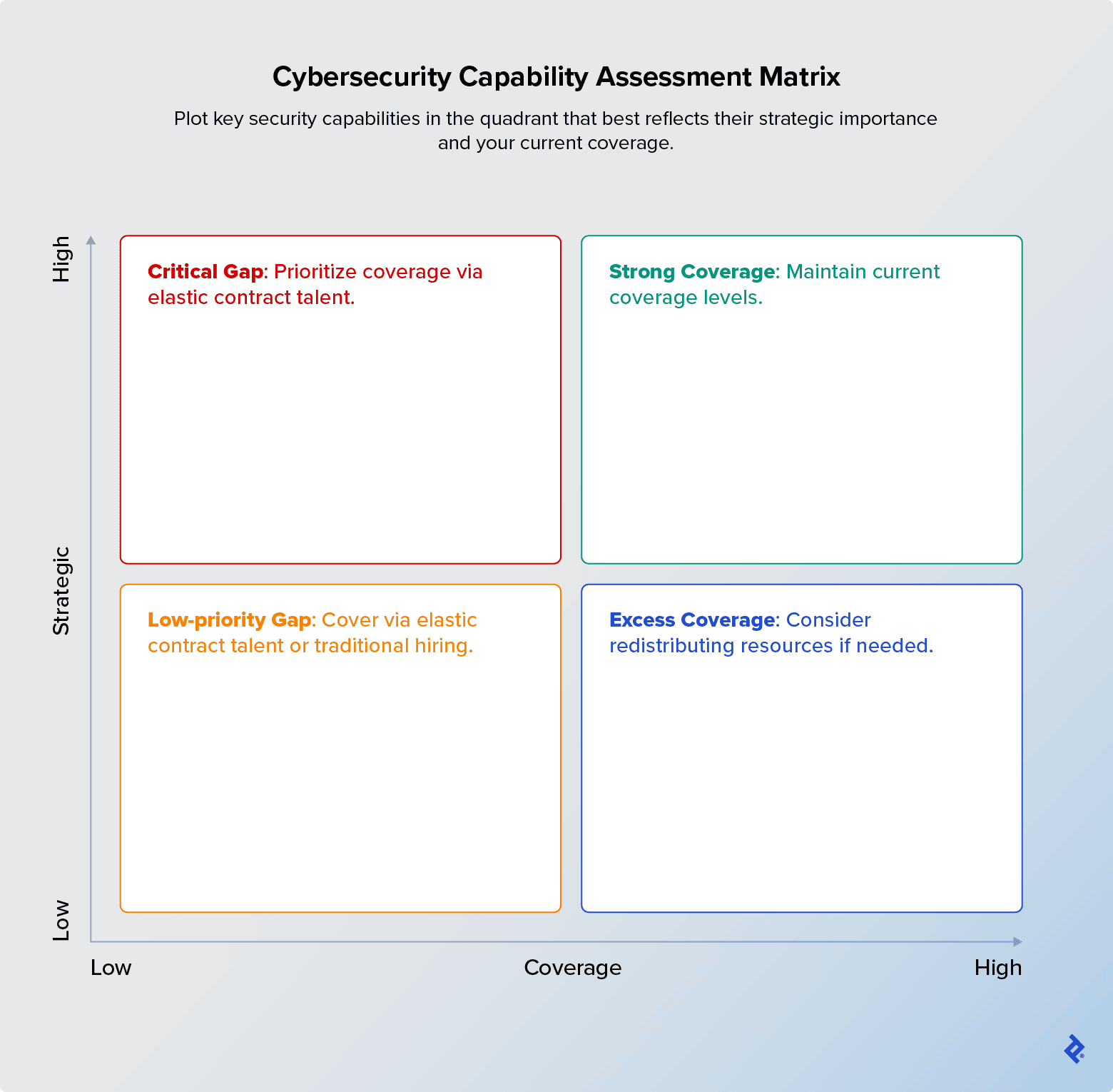
To make this concrete, plot your crew’s capabilities onto the matrix under. The place every lands factors to a particular subsequent transfer.
Functionality areas to contemplate:
- Detection and response: IAM, incident detection and response, EDR
- Proactive safety: software safety, cloud safety configuration, vulnerability administration
- Threat, compliance, and governance: third-party and provide chain threat, regulatory readiness
- Rising dangers: AI/ML threat administration, safety consciousness, insider menace
Frequent Functionality Hole Patterns
When organizations map themselves throughout these functionality areas, we see the identical patterns seem repeatedly. Domains that require steady possession and profit from long-term institutional information are typically comparatively mature and secure. These areas sometimes embrace identification and entry administration (IAM); baseline GRC; and safety operations fundamentals, reminiscent of logging and alerting.
Different capabilities, in contrast, typically stay underdeveloped till a triggering occasion exposes the hole. These areas sometimes floor solely throughout moments of heightened threat, for instance:
- Cloud safety structure throughout large-scale migrations
- Software safety throughout main product releases or platform refactors
- Incident response readiness throughout or instantly after a breach
- Targeted GRC help forward of audits, certifications, or regulatory critiques
Only a few organizations present even protection throughout the complete panorama, and virtually none expertise demand evenly throughout all areas. Threat concentrates erratically, and functionality necessities spike accordingly, particularly in massive, fast-scaling expertise organizations.
In our work with Uber, for instance, safety maturity didn’t hinge on a single operate or crew, however on how capabilities surfaced underneath strain because the enterprise expanded globally. New dangers emerged round identification, third-party entry, knowledge flows, and platform safety that weren’t seen when programs operated at a smaller scale. Capabilities that appeared secure in areas reminiscent of identification governance, entry administration, and platform safety developed quickly as progress, regulatory scrutiny, and architectural change launched new complexity that current buildings weren’t designed to soak up. The aptitude mapping course of we carried out with them made these imbalances specific, revealing the place depth was required briefly and the place long-term possession wanted reinforcement.
In regulated environments, functionality mapping regularly reveals a unique image than anticipated. In our work with healthcare and life sciences organizations, for instance, assessments typically present sturdy maturity in coverage, audit preparation, and perimeter controls, however weaker protection in knowledge governance, identification flows, and operational safety tied to day-to-day workflows. Cloud migrations at these organizations exacerbate this imbalance, as delicate knowledge spans legacy programs, managed providers, and third-party platforms, whereas accountability stays fragmented throughout groups.
What these assessments constantly present is that organizations should not lacking “safety individuals” within the summary. They’re lacking particular capabilities at particular moments. As enterprise circumstances change, these gaps shift, making it impractical for any static crew to cowl all of them with out trade-offs.
Key Takeaway: Functionality-based evaluation shifts the main focus from job titles to capabilities, revealing the place particular experience is lacking and when it’s wanted most. This mapping types the muse for each staffing resolution that follows.
Step 2: Deciding Which Core Capabilities Ought to Keep In-house
Massive Organizations and Enterprises
For giant companies, management, structure, and threat selections needs to be owned by full-time, inner safety specialists, whereas specialised cybersecurity providers are introduced in the place they’re wanted most.
Core safety capabilities anchor decision-making and accountability throughout the group, defining requirements, proudly owning threat selections, and sustaining integration between safety, engineering, and enterprise groups over time. Not like momentary initiatives, these capabilities are likely to span years and stay tightly coupled to enterprise technique, platform evolution, and governance.
Different safety wants floor erratically, with demand rising sharply round particular occasions reminiscent of cloud migrations, main software releases, GRC and compliance preparation, and elevated menace intervals. In these circumstances, depth of expertise and velocity of onboarding matter greater than permanence.
Small and Midsized Organizations
For small and midsized organizations, safety workforce design tends to emerge from constraints. Groups are constructed incrementally, formed by quick dangers, accessible assets, and the necessity to preserve the enterprise shifting.
Most SMBs function with a lean inner safety footprint, despite the fact that they face the identical classes of threat as bigger enterprises, together with ransomware, cloud misconfigurations, third-party publicity, and regulatory scrutiny. Consequently, safety applications should be constructed round a mixture of restricted inner possession and focused exterior help.
The place massive enterprises anchor their core in a full safety management construction, SMBs sometimes focus inner possession in fewer roles: threat acceptance authority, safety structure, IAM governance, and total safety path. These stay inner as a result of they form long-term technique and organizational accountability no matter firm dimension.
Different capabilities fluctuate with operational occasions. Actions reminiscent of cloud-migration hardening, penetration testing, audit preparation, third-party threat assessments, and post-incident response help profit from specialised experience that may be activated when wanted and stood down when the work is finished.
Core in-house crew | Safety management, structure, threat coverage | Safety technique, IT administration, knowledge governance |
Elastic safety workforce | Incident response, AI audits, software safety | Compliance (SOC 2/HIPAA), cloud migrations |
Key advantages | Velocity to market, scalability | Price effectivity, skilled steering |
Over time, as organizations develop or regulatory strain will increase, the inner workforce develops alongside the enterprise, adapting to altering publicity with out forcing untimely permanence.
Key Takeaway: Inside groups ought to personal management, structure, and threat selections that form long-term technique, whereas specialised experience is introduced in for time-bound, episodic wants no matter group dimension.
Step 3: Set up Operational Guardrails
In our work with organizations taken with making use of an elastic expertise mannequin, executives typically categorical the identical issues: value, overreliance on exterior expertise, vetting, and compliance. Mature applications tackle these issues upfront by means of structural options like outlined scope and length and rigorous vetting.
Outline Scope and Length Earlier than Engagement
Elastic specialists needs to be engaged for outlined time frames and particular wants, reminiscent of cloud structure critiques, incident readiness, or audit preparation. Clear scopes make prices predictable and keep away from the overhead of carrying underutilized full-time capability between peak demand intervals.
Hold Structure and Resolution-making Inside
Elastic specialists with particular capabilities needs to be introduced on inside outlined workstreams, not handled as common substitutes for inner groups. Inside workers and leaders ought to retain possession of structure, prioritization, and decision-making, whereas exterior experience augments execution throughout concentrated threat intervals.
Require Rigorous Vetting
Vetting and belief in safety personnel are nonnegotiable. Typical advert hoc contracting might introduce threat that conventional full-time hiring would display out. As a substitute, accomplice with a safety consulting supplier that depends on closely vetted professionals with confirmed safety expertise, background verification, and references. Deal with this bar as nonnegotiable, regardless of how shortly your wants come up, in an effort to transfer shortly with out compromising requirements.
Apply Constant Entry Controls to Exterior Specialists
Elastic specialists ought to function underneath the identical zero-trust ideas utilized to inner workers: least-privilege entry, time-bound credentials, exercise logging, and clear separation of duties. Exterior specialists work inside clearly outlined scopes, whereas inner leaders retain possession of safety selections, threat acceptance, and oversight.
With these guardrails in place, elasticity turns into a managed working mannequin, permitting safety leaders to scale functionality with out introducing new classes of threat.
Key Takeaway: Outlined scope, inner possession of selections, rigorous vetting, and constant entry controls flip elasticity right into a managed working mannequin that scales functionality with out introducing new classes of threat.
What to Do Subsequent
Closing the cybersecurity expertise hole begins with treating workforce design as a threat administration resolution.
Leaders can start by mapping safety capabilities in opposition to how threat truly seems of their group. Some capabilities require steady inner possession, context, and authority. Others floor in concentrated intervals tied to audits, platform modifications, incidents, or product launches.
From there, organizations can design staffing fashions round timing and depth relatively than headcount. That features defining which capabilities should be owned internally, which will be activated on demand, and the way exterior specialists combine into current controls, workflows, and governance buildings.
Lastly, execution issues. Efficient fashions depend on vetted expertise, clear scopes, time-bound entry, and measurable outcomes. When these components are in place, flexibility strengthens accountability relatively than weakening it.
For executives, the trail ahead is concrete: Assess functionality protection, align staffing with how threat truly emerges, and construct mechanisms to entry specialised experience when it issues most. Organizations that undertake this strategy transfer from reacting to threat after it seems to positioning experience the place threat is prone to floor subsequent. In an surroundings the place threats evolve sooner than conventional hiring cycles, workforce design turns into a core element of safety resilience itself.
Have a query for Zohra or her Cyber and Info Safety crew? Get in contact.