
When a buyer submits a help request, textual content classification determines what the message is about and routes it to the proper crew with out ready for somebody to learn it first. The identical expertise processes huge volumes of unstructured textual content daily, figuring out patterns that enable paperwork, messages, and different written content material to be categorized mechanically. The flexibility to impose construction on language has made textual content classification beneficial throughout a broad vary of pure language processing (NLP) methods.
The arrival of huge language fashions (LLMs) has made textual content classification a lot simpler to attain. Duties that after required a specialised NLP mannequin can typically be dealt with by calling an LLM by means of an API and offering directions for evaluation or classification. Because of this, a devoted textual content classification mannequin is now needed for a narrower vary of duties.
This text examines the primary approaches to NLP textual content classification, the issues conventional classifiers nonetheless clear up properly, and when their benefits justify a machine studying engineer constructing a devoted textual content classification mannequin as an alternative of reaching for an LLM.
What Is Textual content Classification in NLP?
Textual content classification is an NLP process that assigns predefined classes to written language based mostly on its which means or content material. In sentiment evaluation, for instance, these classes may merely be optimistic and unfavourable, with every evaluate assigned a label in accordance with the sentiment it expresses.
Conventional classifiers be taught to make distinctions from earlier labeled critiques, figuring out patterns within the language related to every class. With an LLM, task-specific coaching will not be needed; the classes and directions for making use of them could be supplied to the mannequin immediately.
The duty could be utilized to something from a single sentence to a whole doc, relying on what must be categorised. Every bit of textual content may be assigned a single label or a number of labels when classes overlap.
Functions of Textual content Classification in NLP
Any software that should type massive volumes of language into constant classes is a possible use case for textual content classification. It permits organizations to deal with textual content constantly at a scale that will make guide evaluation impractical, notably when new content material arrives repeatedly, as with buyer help messages or social media posts.
The classes themselves rely upon the applying, and the extent of element can differ significantly. Some methods make simple distinctions between a small variety of labels, equivalent to classifying critiques as unfavourable or optimistic, whereas others classify textual content into a whole bunch of topic classes or assign a number of labels to the identical doc.
The next examples element the commonest functions.
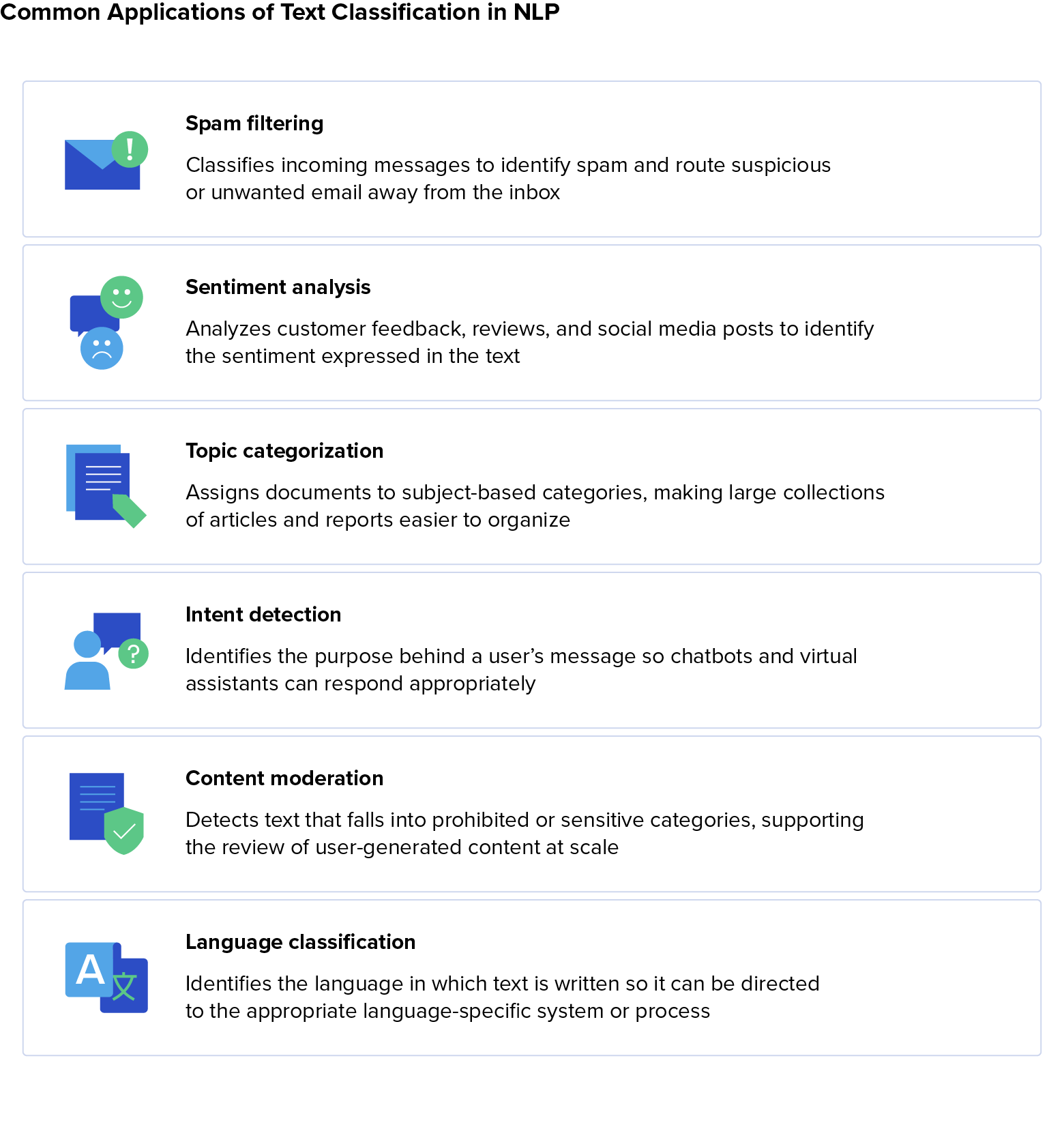
Textual content Illustration and Function Extraction
Machine studying fashions require textual content to be represented numerically earlier than they’ll course of it. This course of, referred to as characteristic extraction, converts traits of the textual content, such because the phrases it accommodates or how ceaselessly they seem, into numerical values known as options. Totally different representations seize completely different details about the unique textual content, starting from the presence of particular person phrases to their order and context. The illustration chosen impacts what patterns a mannequin can detect, in addition to the quantity of knowledge and computation concerned.
Right here’s an outline of the commonest approaches, their limitations, and makes use of.
Approach | The way it Works | Limitations | Widespread Use |
|---|---|---|---|
Bag of Phrases (BoW) | Represents a doc by counting how typically every phrase seems | Discards phrase order and doesn’t seize which means or context | Duties equivalent to spam detection, the place the presence or frequency of explicit phrases can distinguish classes |
Time period Frequency-Inverse Doc Frequency (TF-IDF) | Weights phrases in accordance with their frequency in a doc and their rarity throughout the broader dataset, giving larger weight to extra distinctive phrases | Doesn’t seize phrase order or semantic relationships | Duties like doc categorization, the place distinctive phrases might help separate one subject from one other |
Phrase Embeddings | Represents phrases as teams of numbers, with phrases utilized in related contexts assigned related numerical representations | Assigns the identical illustration to a phrase no matter context when utilizing static embeddings | Duties the place relationships between phrases carry helpful info, equivalent to sentiment evaluation |
Conventional NLP Classification Fashions
Conventional machine studying fashions nonetheless carry out properly on many textual content classification duties and usually require fewer computational assets than deep studying approaches. These fashions be taught from examples of textual content which have already been assigned classes. They’re notably helpful when a mission wants to find out which phrases affect a prediction, in addition to for duties the place LLMs can’t reliably distinguish the classes concerned.
The next sections look at three generally used fashions and the sensible issues concerned.
Naive Bayes
Naive Bayes makes use of patterns in beforehand labeled textual content to estimate which class a brand new piece of textual content is almost certainly to suit. Take into account a classifier that kinds information articles by subject equivalent to enterprise, sport, and leisure. If phrases equivalent to “shares,” “buyers,” or “earnings” happen ceaselessly in articles labeled as enterprise information, their presence in a brand new article makes a enterprise classification extra possible. The mannequin combines proof throughout the textual content, calculates the likelihood of every doable class, and assigns the one with the best likelihood.
The primary issues when utilizing Naive Bayes for textual content classification are:
- Efficiency: Naive Bayes performs properly when particular person phrases are sturdy clues to a class, as they typically do in spam detection or subject classification. It will probably additionally produce helpful outcomes from small coaching units as a result of it learns from simple patterns.
- Effectivity: Coaching primarily includes counting how typically phrases seem in every class and utilizing these counts to calculate possibilities. This doesn’t require a lot computing energy so predictions are fast to supply.
- Interpretability: Builders can look at which phrases the mannequin associates most strongly with every class.
- Limitations: Naive Bayes evaluates phrases largely independently, so it will probably wrestle when the excellence between classes is determined by phrase order or broader context.
Assist Vector Machines
Assist vector machines (SVMs) search for the clearest separation between examples from completely different classes. In a spam classifier, most emails may be straightforward to determine as spam or authentic, however some will share options from each teams. These harder-to-classify examples, referred to as help vectors, assist decide the place to position the boundary between the classes.
A number of sensible issues have an effect on when an SVM is an effective match:
- Efficiency: SVMs have an extended monitor report of performing properly on textual content classification duties and may obtain excessive accuracy with out requiring the big coaching datasets related to many deep studying fashions.
- Effectivity: As soon as educated, SVMs can classify new textual content shortly. Because the dataset grows, coaching takes longer and requires extra reminiscence, which may make SVMs much less sensible when massive volumes of coaching knowledge are concerned.
- Interpretability: With a linear SVM, builders can examine which phrases have the best affect on a prediction. Extra advanced SVMs are, nevertheless, tougher to interpret.
- Limitations: SVMs don’t produce likelihood estimates by default, which could be a disadvantage when an software wants to acknowledge how assured the mannequin is in a prediction. They’ll additionally require extra configuration and tuning than different fashions.
Logistic Regression
Logistic regression calculates how strongly completely different textual content options are related to a class and makes use of that info to make predictions. With a classifier that identifies whether or not a buyer help message is pressing, as an example, phrases equivalent to “outage” or “instantly” may enhance the probability of an pressing classification. The mannequin learns how a lot weight to provide every phrase from beforehand labeled messages.
When utilizing logistic regression, the primary issues embrace:
- Efficiency: Logistic regression is usually used as a place to begin for evaluating fashions, permitting builders to evaluate whether or not extra advanced approaches produce higher outcomes. It will probably additionally obtain aggressive accuracy when the classes have clear variations, with out the information and computational calls for of deep studying fashions.
- Effectivity: Coaching and prediction are comparatively cheap, even with massive collections of textual content. The mannequin may also be retrained comparatively shortly when new labeled knowledge turns into accessible.
- Interpretability: The mannequin assigns a weight to every characteristic, indicating how strongly that characteristic pushes the prediction towards a specific class. Builders can examine these weights to grasp which elements of the textual content are contributing most to the mannequin’s choices.
- Limitations: Logistic regression learns easy relationships between options and classes, so it will probably wrestle when a classification relies upon closely on phrase order or context.
Evaluating Conventional Machine Studying Fashions
When a standard classifier fits the duty, the selection between Naive Bayes, SVMs, and logistic regression is determined by necessities equivalent to the quantity of labeled knowledge accessible and the complexity of the classes.
The next desk exhibits the place every possibility is prone to take advantage of sense:
What the Activity Entails | Greatest Choice | Why |
|---|---|---|
Restricted labeled coaching knowledge | Naive Bayes | It will probably be taught helpful alerts with no need a big coaching dataset. |
Classes with refined variations between them | SVM | It’s designed to discover a exact separation between classes. |
Understanding how particular person options have an effect on a prediction | Logistic regression | Its realized weights present which phrases push a prediction towards or away from a class. |
Frequent retraining as new knowledge arrives | Naive Bayes or logistic regression | Each are usually fast and cheap to coach. |
Very massive coaching datasets | Logistic regression | It handles rising quantities of coaching knowledge effectively. |
Predictions that want likelihood estimates | Naive Bayes or logistic regression | Each present likelihood estimates immediately. |
Pretrained Language Fashions for Textual content Classification
The classifiers mentioned above be taught to determine classes utilizing options extracted from labeled coaching knowledge. Pretrained language fashions construct on broader patterns realized from massive quantities of textual content, permitting them to account for context, together with variations in which means that rely upon the phrases surrounding a time period. For instance, a mannequin classifying buyer help messages can distinguish between “I can’t entry my account” and “I now not want entry to my account,” although each messages include related phrases. A lot of these fashions are suited to duties the place the which means of a sentence as a complete is extra necessary than the presence of explicit phrases.
Builders can take an current pretrained mannequin and fine-tune it for their very own classes, which reduces the quantity of coaching wanted to construct a complicated classifier from scratch and may produce good outcomes with much less labeled knowledge.
BERT and Pretrained Transformer Fashions
Many pretrained language fashions are constructed on the transformer structure. Transformers use consideration mechanisms, which weigh the significance of various phrases, to find out which elements of a textual content are related to 1 one other, serving to the mannequin interpret a phrase in accordance with the context during which it seems.
BERT, or bidirectional encoder representations from transformers, considers the context on either side of a phrase when figuring out its which means. Throughout pretraining, some phrases are masked and the mannequin learns to foretell them from the encompassing language. It additionally supplied the muse for later fashions, equivalent to RoBERTa, which retains the underlying structure however revises its pretraining course of. It was educated for longer on extra textual content and makes use of a special strategy to masking phrases throughout coaching, adjustments that improved its efficiency throughout a number of NLP benchmarks. ALBERT was developed to scale back the variety of parameters, or values realized throughout coaching, wanted as BERT fashions develop bigger. It reuses these parameters throughout a number of layers of the mannequin, considerably decreasing its reminiscence necessities.
Utilizing Giant Language Fashions for Textual content Classification
For a lot of textual content classification duties, notably people who contain deciphering which means, a purpose-built mannequin is now not needed. An LLM can interpret textual content and assign predefined classes from directions equipped in a immediate, which removes a lot of the task-specific growth wanted to construct a classifier from scratch.
For instance, if an organization needs to categorise buyer critiques in accordance with the product options they focus on, a classifier constructed round manually designed textual content options would require builders to account for all of the completely different phrases and phrases clients may use to explain the identical characteristic. An LLM, nevertheless, can acknowledge these variations with out builders defining them upfront. Lowering the quantity of upfront specialist growth work concerned could make an LLM the cheaper possibility, though it might rely upon API pricing and the way closely the system will probably be used.
When an LLM Could Not Be the Proper Alternative
The primary consideration is whether or not the LLM can classify the textual content precisely sufficient for the meant software. Some duties rely upon distinctions that LLMs might wrestle to use constantly. A 2025 research evaluating fine-tuned BERT-like fashions with LLM-based approaches discovered that BERT-like fashions carried out notably properly when the data wanted for classification was contained within the textual content itself, whereas LLMs had a bonus when deeper semantic understanding or world data was required.
A devoted mannequin might also be extra helpful when classification is meant to disclose patterns within the knowledge. For instance, a crew may must measure which phrases are most strongly related to a class with a purpose to uncover the important thing drivers of buyer dissatisfaction. A way like TF-IDF can reveal which phrases are notably distinctive in a set of paperwork, and fashions equivalent to logistic regression can present how strongly particular person options affect a classification, whereas an LLM doesn’t usually present these sorts of statistics immediately.
Effectivity could also be one other consideration when fashions should be educated or tailored for a classification process. In a single 2025 research, LLMs achieved greater classification efficiency total however took 590 instances longer to fine-tune than conventional machine studying classifiers on common.
Implementing Textual content Classification Fashions
Earlier than a mannequin can classify textual content, the coaching knowledge must be ready in a kind it will probably course of. What occurs at this stage is determined by the mannequin: A customized mannequin requires its personal preprocessing setup, whereas a pretrained mannequin equivalent to BERT comes with preprocessing designed for that mannequin. The examples under present how these approaches work in apply.
Preprocessing Textual content With Keras TextVectorization
Uncooked textual content must be transformed into numbers earlier than a machine studying mannequin can course of it. Tokenization begins this course of by splitting textual content into smaller items, equivalent to phrases or subwords. Relying on the mannequin and process, preprocessing may also embrace stop-word elimination, which removes frequent phrases, equivalent to “the” and “and,” or lemmatization, which reduces completely different types of a phrase to a typical base, equivalent to “working” and “ran” to “run.”
Keras 3 offers a TextVectorization layer that may tokenize textual content and convert it into numerical sequences:
import keras

vectorizer = keras.layers.TextVectorization(
    max_tokens=20_000,
    output_mode="int",
    output_sequence_length=200,
)

vectorizer.adapt(training_text)
x_train = vectorizer(training_text)
Right here, max_tokens limits the vocabulary to twenty,000 phrases, whereas output_sequence_length offers every instance a constant size of 200 tokens. Each values could be adjusted to swimsuit the dataset and mannequin.
High quality-tuning BERT for Textual content Classification
High quality-tuning adapts a pretrained mannequin to a selected classification process utilizing labeled examples. As a result of BERT has already realized common patterns in language throughout pretraining, the mannequin can construct on that data when studying the classes required for a brand new process.
KerasHub offers pretrained BERT fashions with the preprocessing wanted to arrange uncooked textual content for the mannequin. The next instance masses BERT and provides a classification layer for 2 classes:
import keras_hub

classifier = keras_hub.fashions.BertTextClassifier.from_preset(
    "bert_base_en",
    num_classes=2,
)
import keras

early_stopping = keras.callbacks.EarlyStopping(
    monitor="val_loss",
    persistence=2,
    restore_best_weights=True,
)

classifier.match(
    train_data,
    validation_data=validation_data,
    epochs=5,
    callbacks=[early_stopping],
)
The instance trains the mannequin for as much as 5 passes by means of the coaching knowledge, referred to as epochs. It additionally checks efficiency in opposition to a separate set of examples to see how properly the mannequin handles textual content it hasn’t educated on. If efficiency stops enhancing, coaching ends early to scale back the danger of overfitting, the place a mannequin learns the coaching examples too intently and struggles with new textual content.
Evaluating Mannequin Efficiency
A mannequin’s total accuracy measures the proportion of classifications it will get proper, however the quantity could be deceptive when classes are erratically represented. If 90 out of 100 buyer messages are routine requests, a mannequin that classifies each message as routine would nonetheless obtain 90% accuracy, although it didn’t determine any of the ten pressing requests.
Different analysis metrics might supply extra perception:
- Precision measures what number of texts assigned to a class really belong there. For an urgent-request classifier, low precision would imply that many routine messages are incorrectly being flagged as pressing.
- Recall measures how most of the texts that must be assigned a class are efficiently recognized. Low recall would imply that many genuinely pressing requests are being missed altogether.
- F1 rating combines precision and recall right into a single measure, which is helpful when each false positives and missed classifications are necessary.
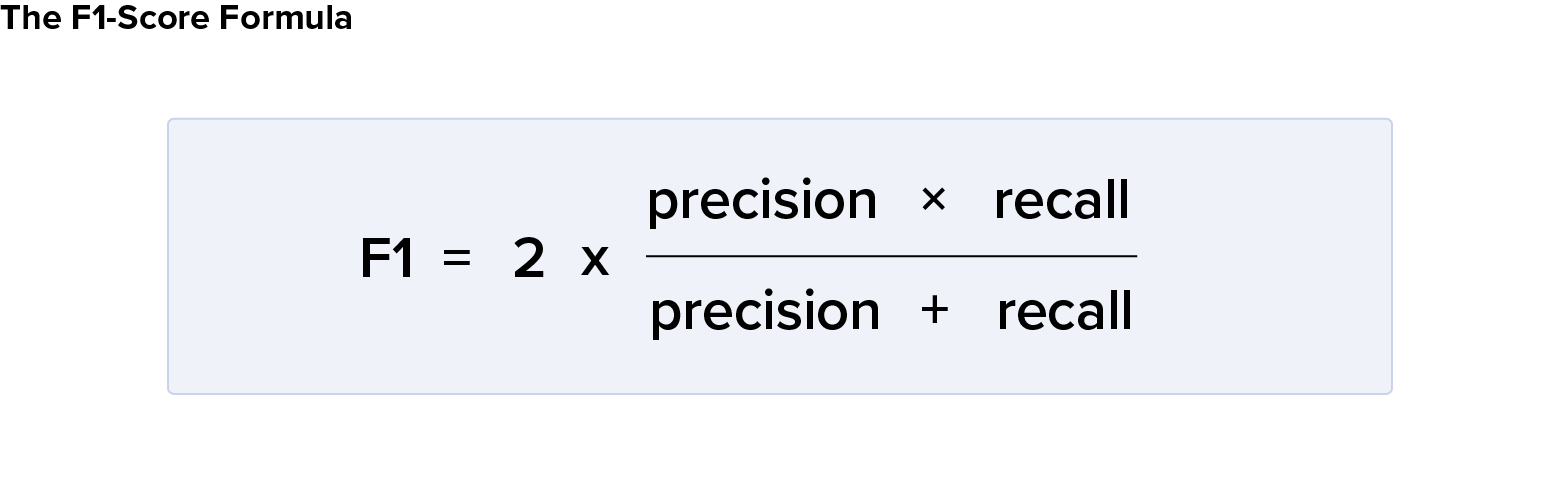
Scikit-learn’s classification_report can calculate these metrics by evaluating the mannequin’s predicted classes with the proper labels:
from sklearn.metrics import classification_report

print(classification_report(y_test, y_pred))
The report offers precision, recall, and F1 rating for every class, making it simpler to determine lessons the place the mannequin performs poorly even when its total accuracy is excessive.
Computational Concerns
Computational necessities dictate the infrastructure wanted to run a textual content classification mannequin and its working prices.
Conventional classifiers equivalent to Naive Bayes and logistic regression can usually be educated and run on central processing items (CPUs), the general-purpose processors present in computer systems and servers, even with comparatively massive datasets.
Pretrained transformer fashions demand significantly extra reminiscence and processing energy, notably throughout fine-tuning. This work is usually carried out on graphics processing items, which may perform many calculations concurrently and subsequently course of the computations concerned in mannequin coaching a lot quicker than a CPU. The assets a transformer mannequin consumes additionally rely upon the scale of the mannequin and the quantity of textual content it processes directly, with bigger fashions requiring extra reminiscence and longer inputs rising the quantity of computation wanted. These calls for can have an effect on each the velocity and value of classification.
With an LLM API, the supplier provides the infrastructure required to run the mannequin. Prices are usually based mostly on the quantity of textual content the mannequin processes and generates, in order that they rise with utilization. For functions processing massive volumes of textual content, working a devoted mannequin on owned or rented infrastructure might lead to decrease working prices.
Selecting the Proper Mannequin for the Classification Activity
For a lot of NLP textual content classification initiatives, an LLM is now a sensible place to start. If it produces sufficiently correct classifications at an appropriate working price, constructing a separate mannequin provides growth work that should ship a tangible profit.
Conventional classifiers and pretrained fashions nonetheless earn that funding in functions the place their explicit properties are necessary. Statistical methods can expose relationships between language and predictions that an LLM received’t quantify, and a devoted mannequin offers builders extra management over how classification is carried out. At enough scale, it is also cheaper to run. Use this easy resolution framework as a fast reference to the primary questions to contemplate.
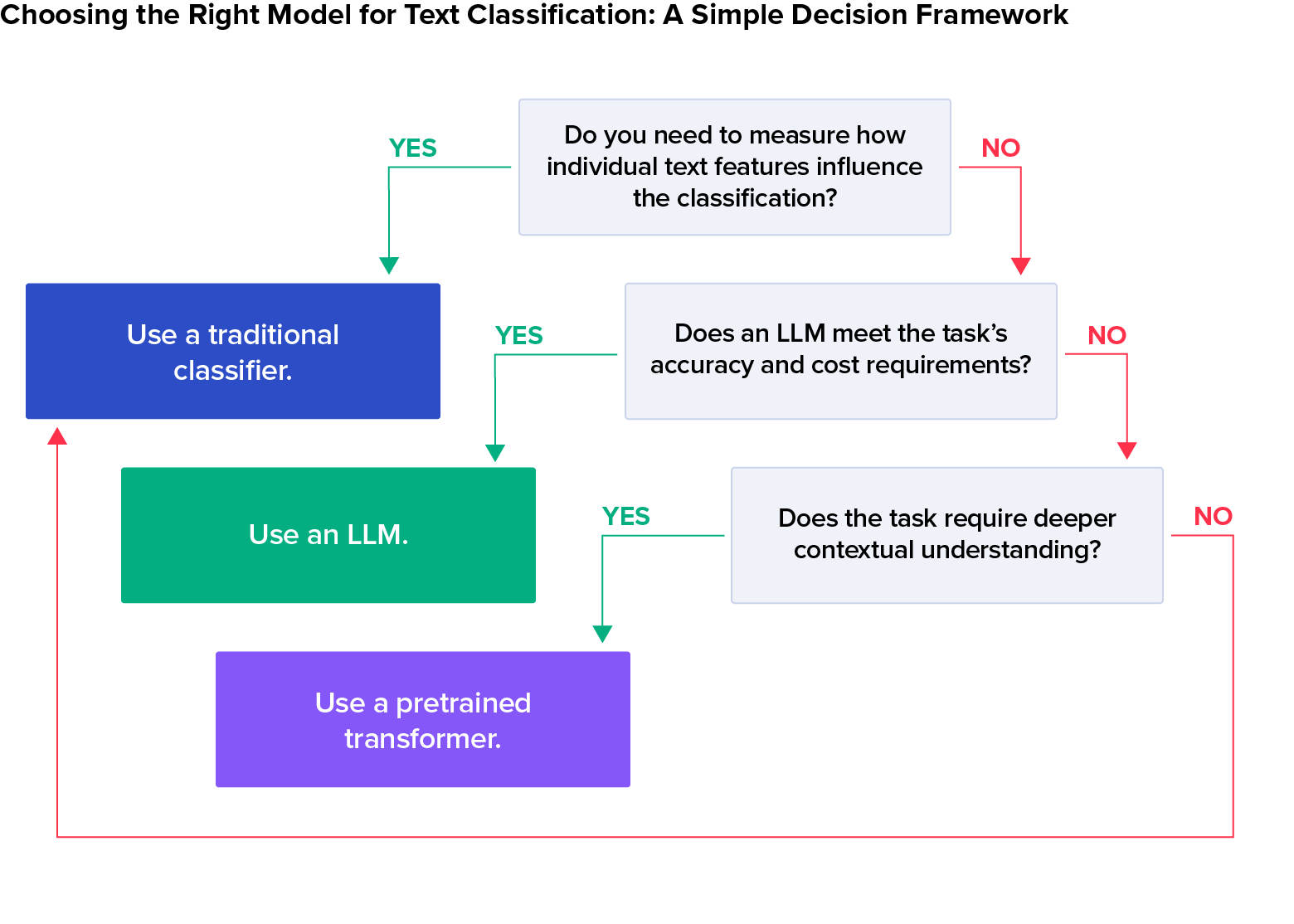
As textual content classification expertise continues to develop, the accessible choices might change, however the necessities of the applying will nonetheless be essentially the most helpful information for selecting the best mannequin for the duty. Beginning there retains the expertise aligned with the issue it’s meant to unravel.