
Introduction
Issues with AI-generated code
In early 2026, I carried out interviews with 26 builders working for
a company that was closely invested in creating with AI coding
brokers. One in all my questions was “do you belief our assessments?” In spite of everything, the
builders had been from Thoughtworks, and Thoughtworks prides itself on the
high quality and thoroughness of our testing. Sadly, the builders
invariably answered “Nicely… I don’t belief our assessments that a lot! As a result of
even when I evaluation the assessments when they’re initially generated, as new
options get added, the AI refactors each current code and current
assessments, so I’m not assured that the assessments are nonetheless guaranteeing the
proper behaviour”.
This bought me pondering. As we be taught to get extra work finished from coding
brokers, it’s changing into pure that AI writes most, if not all of the assessments.
The follow of builders writing automated assessments was a significant
breakthrough in software program engineering within the late twentieth century. Probably the most
sensible approach to do that is to jot down the assessments earlier than the code
(test-first) and to jot down and make go one take a look at at a time (test-driven
improvement). This follow allowed groups creating enterprise software program
to ship almost bug-free code, at a fraction of the price of formal
specs and proofs.
In 2026, a whole lot of code is written by AI coding brokers, and people
brokers will generate assessments even with out asking, so one may hope that
we are able to obtain the identical stage of correctness that human coders loved
with TDD. Sadly, it’s a typical expertise that this isn’t the
case. The truth is, there have been quite a few stories printed in early
2026 displaying that the standard of code being deployed by organizations is
getting worse.
I don’t know for sure what the causes are of this broadly reported lower in exterior high quality,
however I feel it’s believable that one of many causes could also be a decline in high quality of the automated
purposeful assessments.
Issues with AI-generated assessments
Once we give excessive autonomy to AI to generate code, we have to belief
the AI to jot down good assessments, as the choice of writing all of the assessments
by hand is not life like. Let’s get again to the issue reported
by the builders who stopped trusting the assessments when the AI
refactored them. Why does the AI refactor the assessments? Most probably, it
must refactor them as a result of the signature of a perform modifications as
the code evolves, and that is anticipated to occur in the middle of
improvement, so the AI isn’t “unsuitable” when it does this. However studying
AI-generated take a look at code is much more boring than studying AI-generated
manufacturing code, so it’s not life like to count on builders to
rigorously re-read all modified take a look at code at each step.
One other downside with AI-generated assessments is that they could be
tightly coupled to the implementation. If we ask a coding agent to
“cowl module X with unit assessments”, it’s going to fortunately generate a whole lot of
assessments, and sometimes these assessments will use a number of mocks and stubs.
The aim of assessments is to interrupt when the code returns the unsuitable
end result, or produces the unsuitable unintended effects. Sadly, assessments that
use mocks and stubs closely have a tendency to interrupt at any time when the implementation
of the stubbed and mocked code modifications, even when the change is a
innocent refactoring that preserves correctness. So these assessments
produce a whole lot of false positives. What’s worse is that these assessments
may not give us confidence that they are going to shield us when the code
does the unsuitable factor. As a substitute of proving that “when enter is X, output
have to be Y”, these assessments would possibly simply show that “after we invoke perform
A, it’s going to invoke perform B”, which isn’t helpful, as a result of it’s not
proving that the code will produce the proper outcomes. The truth is, when
we ask AI to cowl one thing with assessments, we’d just like the assessments to
specify the proper behaviour, however most frequently, the AI will write assessments
that verify the present implementation, together with any bugs it might
include.
So in abstract, AI-generated assessments are sometimes problematic
as a result of:
- The quantity of take a look at code is massive
- Take a look at code is difficult to learn
- The assessments are coupled to the implementation, and
- They may not even show that the code is right
We may mandate that human builders write all of the assessments, and
write good assessments, however this may negate many of the anticipated financial
advantage of coding brokers, and isn’t life like given the place software program
engineering appears to be heading. However what if there was a technique to write
assessments that’s a lot simpler for people to each learn and write? That is
what we’ll cowl in what follows.
Issues with AI-generated specs
Numerous AI-assisted improvement is finished utilizing some type of spec-driven improvement:
distributors suggest it and
some SDD frameworks are highly regarded. Whereas it appears clear that aligning with AI earlier than improvement is
very helpful, e.g., by getting the AI to ask clarifying questions, there are issues with the technology
of “specs” written as prose in Markdown paperwork.
One downside is that, once more, the amount of generated prose makes it laborious for builders to learn all of it.
After some extent, fatigue kicks in and we threat accepting the AI-generated plans after little greater than a
cursory look, in what somebody referred to as cognitive give up. One other downside is
upkeep: as soon as a function is full, what will we do with all of the specs? Some frameworks help
sustaining a set of sturdy specs, however the threat, once more, is that over time the amount of those specs develop
too massive for upkeep. A 3rd downside is that large-language fashions don’t adjust to the entire
detailed specs; it might probably occur that the AI provides up on some components of the spec as a way to declare
“finished” sooner.
Lastly, and most essentially, English is ambiguous: whereas we are able to attempt to specify what we would like as
exactly as we are able to, pure language doesn’t afford the extent of precision that we
get with programming languages. In brief, prose specs cannot be executed; assessments can.
What I’m proposing
Our purpose is to have assessments that exhibit these properties:
- They predict success
in manufacturing: when all of the assessments go, it provides us confidence that the performance is
applied appropriately and it’ll behave as anticipated in manufacturing - They’re proof against refactoring
- They’re as straightforward to learn as attainable
To attain this, we suggest these strategies:
- Buyer assessments: write within the language of the shopper.
- Black field: take a look at the system, or parts of the system from the skin, with out
mentioning implementation particulars of the manufacturing code. - Assessments-as-data: give attention to the necessary particulars: the enter, the anticipated output or facet
results, and the take a look at setup. In different phrases, the take a look at ought to seize simply the information, with out
mentioning implementation particulars within the take a look at code. - Take a look at DSL: discover probably the most simple methods to symbolize the enter, the output and the
system state in textual content that may be understood by a website knowledgeable, and produces a clear diff
when the take a look at fails.
When AI writes the code, the builders turn out to be in a approach prospects. The assessments are a contract that
establishes what the code ought to do for us, and transferring assessments to knowledge information, interpreted by a comparatively smaller take a look at runner,
makes them simpler to guard from sudden manipulation by AI.
The identical AI makes it straightforward to jot down take a look at runners that run our take a look at DSLs.
The place does this go away TDD? Given how a lot people profit from TDD when coding, can we count on AI to
do a greater job after we ask it, or pressure it, to make use of TDD in its internal coding loop? Getting AI to observe
canon TDD isn’t straightforward, as a result of AI often
generates a number of code earlier than writing assessments. Then again, it appears that evidently coding brokers carry out
higher after we simply inform them what we would like and validate the end result: including
directions on obtain the end result appears to make
them carry out worse.
The strategies mentioned right here present the “ validate the end result” that coding brokers want. In a
approach, we may see this as a technique to do test-first, with bigger steps. Usually talking, taking smaller
steps makes improvement safer; nevertheless, the purpose of this text is to debate methods to allow taking
bigger steps safely.
Core strategies
Buyer assessments
Builders writing assessments was one of many authentic practices of
Excessive Programming. The ensuing assessments are typically referred to as
“developer assessments” as a result of they help builders in guaranteeing that
their code does what they suppose it ought to. (Most builders name them
unit assessments.) One other one of many authentic XP practices was Buyer
assessments, also referred to as Acceptance assessments.
A buyer take a look at is a take a look at written within the language of the shopper;
it describes what the software program ought to do, from the standpoint of the
customers.
The concept is {that a} buyer can perceive what a buyer take a look at is attempting to
show, in order that these assessments assist deliver alignment between buyer and builders.
The attention-grabbing half is that when a machine is writing many of the code, the
human builders begin enjoying increasingly more the a part of the “prospects” of the
code. We’re fascinated with specifying what the software program ought to do, in phrases that
are as freed from implementation particulars as we are able to, as a result of we’re delegating these
implementation particulars to the AI.
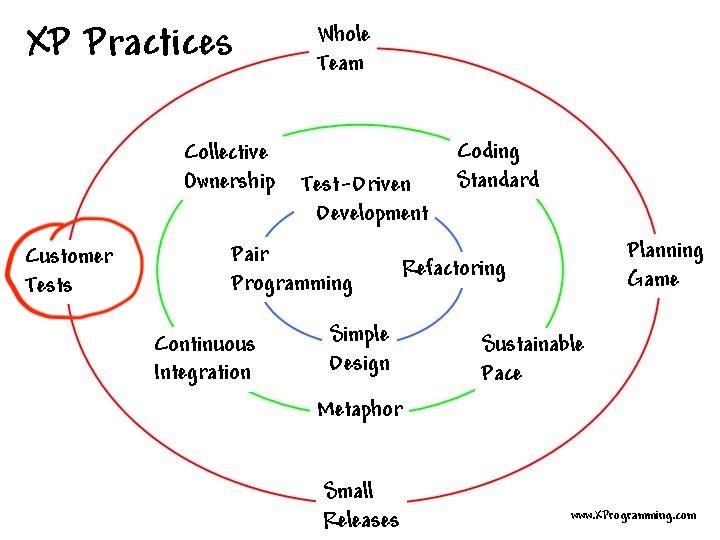
The circles of Excessive
Programming practices. Picture by Ron Jeffries, used with permission.
That is why I feel that buyer assessments are the
main type of assessments that we should always depend on; particularly when
manufacturing code is AI-generated. Unit assessments (developer assessments) can
nonetheless be helpful, however we don’t deal with them as the first supply of
fact the place specifying behaviour is anxious.
Buyer assessments:
- Outline the purposeful content material of a person story, in order that once they go, we
know that the story is functionally full - Defend us towards regressions: as soon as a buyer take a look at passes, it should all the time
go, till the enterprise rule that it’s testing modifications - Assist refactoring, as a result of they take a look at behaviour, not implementation
- Final however most likely most necessary: they’re a instrument for guaranteeing alignment
between builders and prospects. The purchasers can learn and perceive the
take a look at, and may present suggestions to make sure that we’re testing the appropriate
factor.
Then again, buyer assessments would possibly show troublesome to work
with. Particularly when they’re applied as end-to-end assessments, they
will be gradual and flaky. There are methods to beat these issues,
and we are going to talk about them within the coming sections.
Concentrate on what issues
Let’s have a look at how we are able to repair the issue of hard-to-read assessments.
Think about the next easy instance:
@Take a look at
void defaultGreeting() throws IOException, InterruptedException {
    HttpRequest request = HttpRequest.newBuilder()
            .uri(URI.create(baseUrl + "/good day"))
            .GET()
            .construct();

    HttpResponse<String> response =
            consumer.ship(request, HttpResponse.BodyHandlers.ofString());

    assertEquals(200, response.statusCode());
    assertEquals("Good day, world!", response.physique());
}

@Take a look at
void personalisedGreeting() throws IOException, InterruptedException {
    HttpRequest request = HttpRequest.newBuilder()
            .uri(URI.create(baseUrl + "/good day?identify=Joe"))
            .GET()
            .construct();

    HttpResponse<String> response =
            consumer.ship(request, HttpResponse.BodyHandlers.ofString());

    assertEquals(200, response.statusCode());
    assertEquals("Good day, Joe!", response.physique());
}
Are you able to instantly spot what the assessments try to show? A
skilled eye will give attention to the necessary bits, which can be highlighted
under:
@Take a look at
void defaultGreeting() throws IOException, InterruptedException {
    HttpRequest request = HttpRequest.newBuilder()
            .uri(URI.create(baseUrl + "/good day"))
            .GET()
            .construct();

    HttpResponse<String> response =
            consumer.ship(request, HttpResponse.BodyHandlers.ofString());

    assertEquals(200, response.statusCode());
    assertEquals("Good day, world!", response.physique());
}

@Take a look at
void personalisedGreeting() throws IOException, InterruptedException {
    HttpRequest request = HttpRequest.newBuilder()
            .uri(URI.create(baseUrl + "/good day?identify=Joe"))
            .GET()
            .construct();

    HttpResponse<String> response =
            consumer.ship(request, HttpResponse.BodyHandlers.ofString());

    assertEquals(200, response.statusCode());
    assertEquals("Good day, Joe!", response.physique());
}
By specializing in the take a look at identify, the enter and the anticipated
output, it turns into clear that the assessments try to show: the
normal greeting is “Good day, world!”, and the greeting when a
identify is offered is “Good day, <identify>!”. Each different little bit of code
is boilerplate that makes seeing the take a look at intent more durable.
So
why do not we give attention to simply these three issues? What if we simply
wrote one thing like
suite: greetings
assessments:
  - identify: "default greeting"
    request:
      useful resource: "/good day"
      identify: null
    greeting: "Good day, world!"
  - identify: "personalised greeting"
    request:
      useful resource: "/good day"
      identify: "Joe"
    greeting: "Good day, Joe!"
This yaml file can be utilized as a supply of take a look at circumstances by a
parameterized take a look at that could be very straightforward for the AI to jot down. A
regular course of could be:
- Draft a pattern of the take a look at domain-specific language (DSL)
that you simply’d prefer to have - Get the AI to jot down a take a look at runner for it
- Each human and AI combine another helpful take a look at circumstances; for
occasion
- identify: "identify should not be completely whitespace"
  request:
    useful resource: "/good day"
    identify: " "
  error: "Identify should not be completely whitespace"
We will make this much more concise by extracting a desk that
will be saved in a CSV file
test_name,             useful resource, identify, greeting,         error
default greeting,      /good day,   null, "Good day, world!",
personalised greeting, /good day,   Joe,  "Good day, Joe!",
not whitespace,        /good day,   " ",  null,             Identify should not be completely whitespace
Why tables? As a result of a desk makes it straightforward to see at a look what
circumstances are coated, and what circumstances could also be lacking. As well as, a
desk makes it simpler so as to add new take a look at circumstances.
This, in essence, is tests-as-data. How does this assist with the issue of
builders not trusting assessments? It helps as a result of the assessments are (1) centered on the
half that’s of most curiosity to us as developer-customers, (2) extra proof against
refactoring, and (3) when the assessments are written in textual content information, it is simpler to
spot when AI is altering them.
Tables work properly when the enter to the appliance, the setup state and the anticipated
output are single, scalar values. When they’re structured knowledge, we have to use
structured eventualities, coated under.
Not all assessments can slot in tables
When the inputs of the take a look at aren’t a easy worth, the tabular format doesn’t suffice. We will then flip to extra structured eventualities. My first publicity to the concept of buyer assessments got here from Ron Jeffries’ e-book Excessive Programming Adventures in C#, printed in 2004. He describes the event of an editor for articles with XML markup, and begins with this buyer take a look at (rewritten for readability):
---- earlier than ----
<p>Fo|o</p>
<p>Bar</p>
----------------
* press enter
---- after ----
<p>Foo</p>
<p>|</p>
<p>Bar</p>
----------------
The intent of the take a look at is to indicate what ought to occur when the person presses the enter key when the cursor, represented by the “|” character, is in the course of a paragraph. Jeffries continues displaying how you possibly can write a easy runner for this take a look at. From the start, this buyer take a look at lives in a textual content file.
One other instance: when creating programming language interpreters or compilers, I all the time thought that
the waterfall method of designing the grammar first after which every processing stage is much less efficient
than beginning with the only significant program you possibly can outline, which for many languages is a “Good day,
world!”, after which constructing language options one take a look at at a time. Working this manner with coding brokers makes
it attainable to jot down very difficult interpreters and compilers safely. Right here’s an instance from a BASIC
interpreter experiment, and this method scales to way more difficult languages.
assessments:
  - identify: "LEN perform fundamental assessments"
    program: |
      10 PRINT LEN("HELLO WORLD")
      20 PRINT LEN("")
      30 PRINT LEN("A")
      40 END
    anticipated:
      - "11n"
      - "0n"
      - "1n"
  - identify: "LEFT$ perform fundamental assessments"
    program: |
      10 PRINT LEFT$("HELLO WORLD", 5)
      20 PRINT LEFT$("HI", 10)
      30 PRINT LEFT$("TEST", 0)
      40 PRINT LEFT$("HELLO", 3)
      50 END
    anticipated:
      - "HELLOn"
      - "HIn"
      - "n"
      - "HELn"
How would we take a look at an internet software? Right here’s an thought for testing a easy todo-list app:
## Unchecking a accomplished todo reactivates it
GIVEN mannequin:
    [x] purchase milk
    [ ] stroll the canine
WHEN person:
    click on toggle of "purchase milk"
THEN web page:
    > ""
    [ ] purchase milk
    [ ] stroll the canine
    -- **2** objects left
THEN mannequin:
    [ ] purchase milk
    [ ] stroll the canine
The show of the appliance, that renders like this:
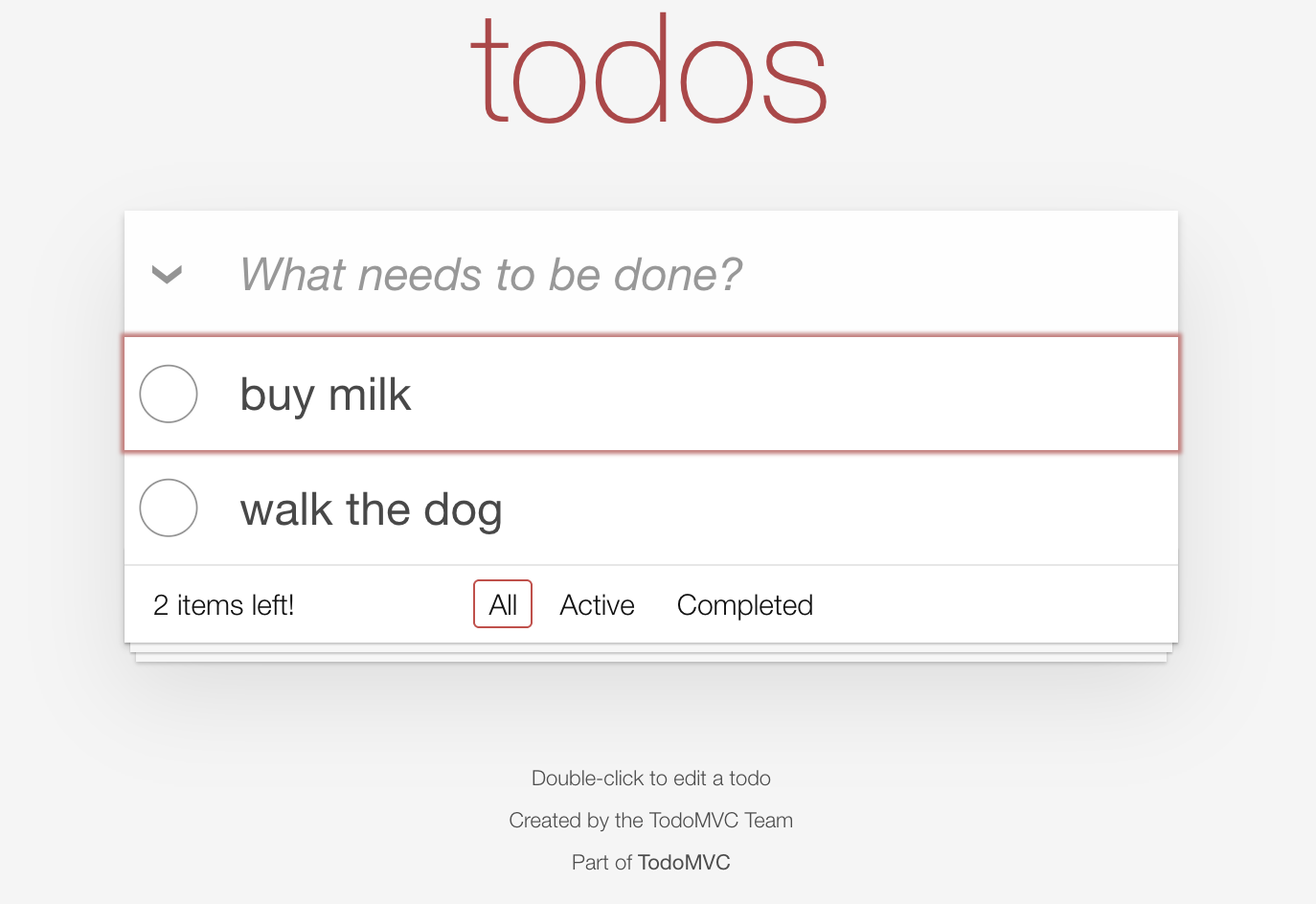
is simplified from the unique HTML to this:
> ""
[ ] purchase milk
[ ] stroll the canine
-- **2** objects left
This textual illustration is simple to insert in assessments, it produces a transparent “diff” when a take a look at fails,
and is powerful towards modifications within the visible look of the UI. The perform that transforms the HTML,
or the DOM, to this textual illustration is known as a “projection”, or extra merely, a printer.
On this instance we use one other printer, that reveals the contents of the inner state of the
software. It is within the THEN mannequin part and it makes use of a syntax much like the one
produced by the UI printer. It was added as a result of when testing an operation that’s supposed to alter the
state, like on this case unchecking a todo merchandise, we shouldn’t be glad with simply seeing the
change within the UI: we would like to make sure that the persistent state of the appliance was modified as
properly.
Alongside the 2 printers, on this instance we additionally make use of two parsers: the primary one is used
within the GIVEN mannequin part, the place the beginning state for the take a look at is represented, and is used
to arrange the appliance state the best way the take a look at wants it to be. The second parser is used within the
WHEN person part, to parse the command that we ship to the appliance. Its job is to
acknowledge a vocabulary of operations that may be utilized.
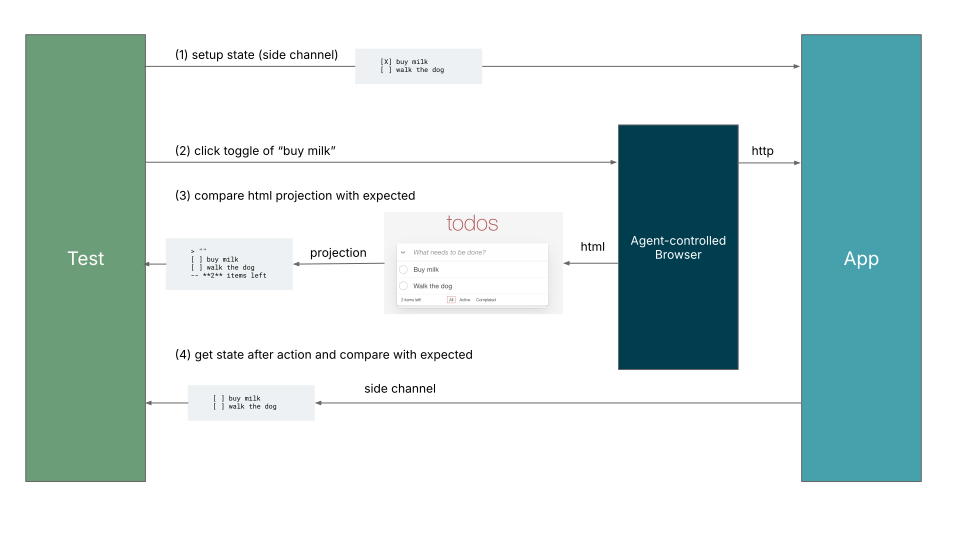
Sequence diagram displaying how the todo-list take a look at works.
The printer and parser for the appliance state will need to have some technique to entry and manipulate the appliance state itself; this may be achieved by means of a facet channel.
All the above mechanisms are used collectively in a take a look at runner {that a} coding agent can simply generate.
Constructing on current traditions
Match and specification by instance
Ward Cunningham is credited as originator of most of the concepts
that later had been popularized in Excessive Programming. Cunningham tells
about how across the yr 2002, his prospects tended to offer
their very own specs in Excel paperwork. Drained
of copying the take a look at knowledge from Excel to check code, he wrote a
program that learn the take a look at knowledge from Excel and
executed the assessments robotically. This made it very straightforward for his
prospects to increase and refine the specification, and for him to
confirm that his applications matched the specification itself. He
referred to as this instrument Match and it has implementations
for numerous programming languages.
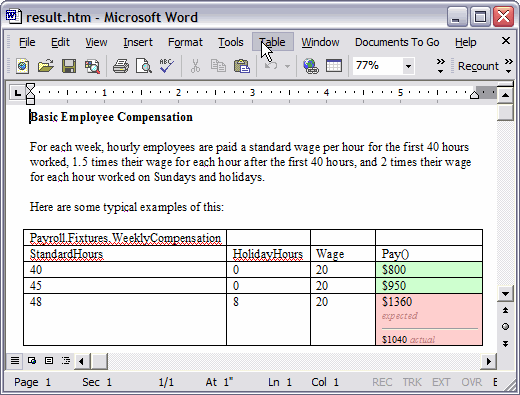
A screenshot of Match displaying the outcomes of a take a look at. Picture by James Shore, used with permission.
In 2004, Martin Fowler printed his article on Specification
by
Instance,
that just about sums up the concept: difficult necessities will be
clarified by getting builders and enterprise individuals to agree on
examples of what ought to occur. Later, in 2011, Gojko Adzic
printed a e-book with the identical
title, and by
then quite a few related approaches had been rising, the most well-liked
being Cucumber and its language
Gherkin.
The Specification by Instance custom popularized buyer
assessments; however the method was not with out prices. Automating the
extraction of tables from doc will be gradual and fragile, and
Cucumber requires a layer of interpretation code that typically can
be a supply of bugs and misunderstandings.
James Shore was an early adopter of Match, and maintained lots of its implementations. He later turned disillusioned with the method, lamenting that, whereas the first objective of the instrument is to enhance communication with prospects, most prospects didn’t need to write the take a look at tables, which led him to have the conversations with the shoppers after which write the Match assessments himself. Later, utilization of Match (and Gherkin) was generally delegated to QA groups to check software program after-the-fact, which defeats the unique objective of facilitating a dialog with the shoppers. For these causes, he reckoned that if the shoppers will not write the assessments, then the upkeep overhead of the Match or Gherkin runners isn’t well worth the worth, and writing assessments in code makes extra sense.
The truth that prospects do not need to write buyer assessments is commonly quoted towards the follow of buyer assessments. I feel that the state of affairs we’re in right this moment modifications this reality, as a result of:
- When the AI writes most manufacturing code, then human builders are within the place of shoppers: we
describe what we would like, and supply suggestions on what we get, identical to prospects have all the time finished. - Writing and sustaining the equipment that runs the shopper assessments is one thing that coding brokers can do shortly and cheaply.
Specification by instance may help with the issues with spec-driven improvement described within the introduction, by clarifying the acceptance standards with examples, in order that their description will be a lot shorter. By making these assessments an integral a part of the specification, we make the specification executable and unattainable to bypass by the coding brokers. And these specs can’t go stale, as a result of they run in CI.
Testing practices in Go
A associated method comes from the custom of the Go programming
language, the place most assessments are tabular. For instance, right here is how the
“fmt” bundle is examined:
var fmtTests = []struct {
    fmt string
    val any
    out string
}{
    {"%d", 12345, "12345"},
    {"%v", 12345, "12345"},
    {"%t", true,  "true"},

    // fundamental string
    {"%s",    "abc",              "abc"},
    {"%q",    "abc",              `"abc"`},
    {"%x",    "abc",              "616263"},
    {"%x",    "xffxf0x0fxff", "fff00fff"},
    {"%X",    "xffxf0x0fxff", "FFF00FFF"},
    {"%x",    "",                 ""},
    {"% x",   "",                 ""},
    {"%#x",   "",                 ""},
    {"%# x",  "",                 ""},
    {"%x",    "xyz",              "78797a"},
    {"%X",    "xyz",              "78797A"},
    {"% x",   "xyz",              "78 79 7a"},
    {"% X",   "xyz",              "78 79 7A"},
    {"%#x",   "xyz",              "0x78797a"},
    {"%#X",   "xyz",              "0X78797A"},
    {"%# x",  "xyz",              "0x78 0x79 0x7a"},
    {"%# X",  "xyz",              "0X78 0X79 0X7A"},
    //[...]
The above creates an array of structs composed of: the format
being examined, eg “%x”, the enter string, eg “abc”, and the ensuing
formatted textual content, on this case “616263”. A brief take a look at runner executes
all of the rows on this desk towards the fmt perform. Many features
within the Go normal library are examined in an analogous approach.
Once more in Go, there’s a longtime follow of writing eventualities in textual content information, notably when
the take a look at relies on the existence of information, or checks that information are created. Right here is an instance of how the go command line instrument is examined:
env GO111MODULE=off

# good day world
go run good day.go
stderr 'good day world'

-- good day.go --
bundle important
func important() { println("good day world") }
We see that a customized DSL was developed for the aim of testing the central Go utility program. The take a look at workouts the go run subcommand. The DSL permits the take a look at author to outline an atmosphere variable, setup a file, execute a command and test the ensuing output on the usual error channel.
Approval testing
A 3rd related custom is that of Approval
Assessments, popularized by Llewellyn Falco, the place it’s common
to get a system to generate a file that
could symbolize a sequence of computations, or what the UI seems
like at a specific second, or a readable illustration of the
inside state of the system; the primary level is that the
illustration we get is comprehensible by people, who can then
approve it. As soon as a file is authorized, it may be
regenerated in future runs and at any time when the newly generated file
differs from the authorized one, it alerts that the behaviour of
the system has modified. The mechanism for operating these assessments
entails a take a look at runner, that may come from an approval testing
library, or will be generated advert hoc by a coding agent. This
method is related for our pursuits right here, as a result of it stresses
that what people have a look at isn’t take a look at code, however take a look at knowledge.
One key thought to take from approval testing is to search out methods to
make software state and output readable and “diffable”, which means
that when a take a look at fails, we are able to see a clear textual diff between
what was anticipated and what we bought.
Llewellyn Falco and Lada Kesseler give an amazing rationalization of Approval Testing in
follow (video)
Authorized Eventualities and Authorized Logs
Ivett Ördög has been selling the strategies I am describing on this article for a while. She printed the Authorized Eventualities and Authorized Logs patterns, the place she advocates utilizing a domain-specific language to precise buyer assessments. The primary sample is for after we specify behaviour upfront; the second depends on the operating system to generate a textual illustration of its state, that may be tweaked and used to generate new assessments, particularly when testing current techniques, or writing a failing take a look at as step one in the direction of bug fixing. Her video explains the strategies in additional element.
A typical Authorized Situation or Authorized Log DSL consists of three components: the setup of the state of the system, the motion or actions to be executed, and a illustration of the state of the system after the actions. The method by which one would get began is to:
- Determine on a DSL format, probably in collaboration with the AI, and write a primary take a look at
- Have a coding agent generate the DSL parser and take a look at runner
- The developer checks that the runner works appropriately, by checking it towards manufacturing code
- The coding agent provides eventualities, utilizing the primary take a look at as a template
My interpretation is that the Authorized Eventualities sample is utilized to a system that has already
sufficient construction to make a significant first take a look at attainable, in a approach much like the Spike and Stabilize sample described by
Dan Terhorst-North. An alternate approach, when ranging from scratch, might be that the primary take a look at is
used to generate a
Strolling Skeleton.
The 2 patterns are cases of what Ördög calls the Constrained Assessments sample, the place a coding agent can’t simply “cheat” by writing assessments which can be weaker than anticipated. Authorized Eventualities and Logs make dishonest much less probably, by making the assertion a part of the take a look at obligatory within the DSL syntax, and this requires that the DSL is applied with a parser, i.e. an exterior DSL.
Ördög argues that if we implement an inside testing DSL, which is solely a
assortment of features outlined within the programming language we’re utilizing, then an agent may write assessments
with no assertions, or weak assertions, thus faking a excessive take a look at protection rating whereas the assessments aren’t
testing the system as anticipated. An exterior DSL, the place the assertions are an integral and obligatory half
of the DSL syntax, makes this downside much less probably.
So, one objective of the Constrained Assessments sample is to make sure that take a look at protection is a dependable indication of what components of the code are examined, and this makes the overhead and indirection of an exterior DSL worthwhile.
Implementation hints
Not all the time end-to-end
It is not uncommon to implement buyer assessments as end-to-end assessments
passing by means of the UI. This may be OK, however it isn’t the one
approach. One downside with all buyer assessments being end-to-end is
that the assessments turn out to be slower, and extra fragile. A great way to
keep away from that is to execute most assessments bypassing the UI. Many
enterprise functions have a service
layer,
that may be a set of lessons, or features, which can be invoked by the
UI and by different entry factors within the system, to execute enterprise
operations. The assessments can invoke the service layer, bypassing
the UI completely. This is sensible in lots of domains the place logic is
way more difficult and troublesome to get proper than the UI,
for instance within the monetary area. An instance from my
expertise was when, within the insurance coverage area, we got a
difficult algorithm for matching a declare with a lawyer.
Writing the shopper assessments helped us make sure that we understood
precisely what the shopper wished to attain, and we applied
it as a service-level take a look at.
One other downside is when the entry level of your take a look at is much,
when it comes to variety of perform calls, from the logic that you simply
need to train.
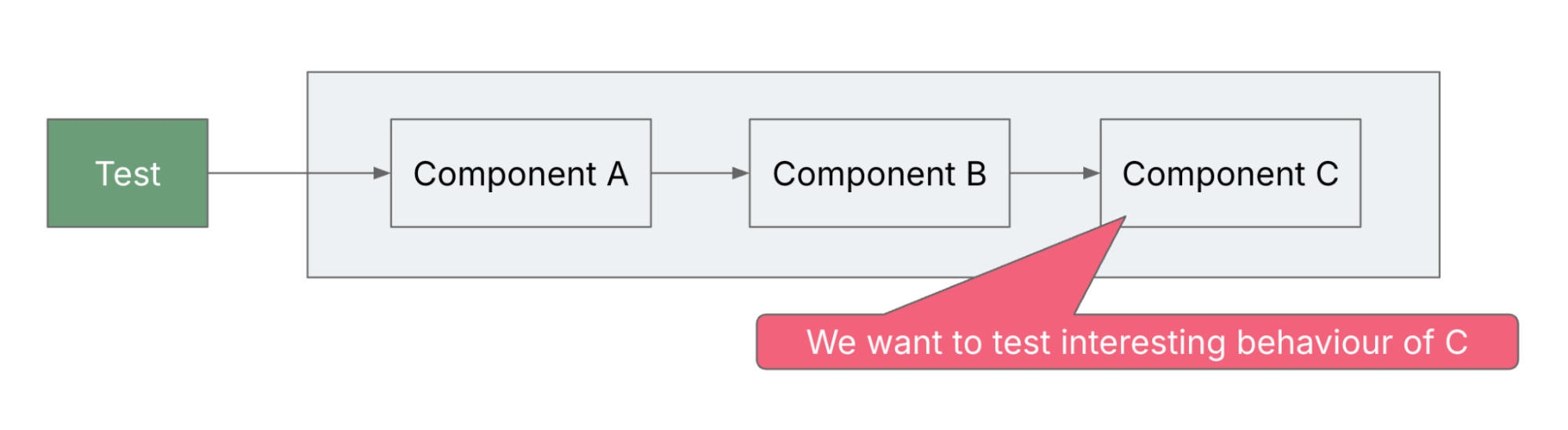
On this instance, we need to take a look at some attention-grabbing logic in a
element “C”, however so as to take action, our take a look at should “persuade” the
intervening element “A” to arrange appropriately element “B” in
a approach that it units up appropriately element “C”. This may be
awkward, and should result in a sense of attempting to construct a ship in a
bottle, attempting to arrange tiny particulars utilizing sticks by means of the
opening of the bottle.
We don’t have to do that; when now we have an necessary element
that we need to specify intimately, we are able to write buyer assessments for
it straight. Keep in mind that a very powerful factor a few
buyer take a look at is that it helps alignment between prospects and
builders. An instance is that this take a look at for a element that checks if
the person’s IP handle matches an allowlist. The allowlist was
sufficiently difficult that we didn’t really feel assured testing it
with end-to-end assessments alone, so we wrote a centered buyer take a look at,
applied as a unit take a look at, full with its personal customized take a look at
DSL.
assessments:
  - identify: "is_ip_allowed respects enabled flag"
    allowlist:
      - { id: 1, ip_or_cidr: "10.0.0.1/32", is_enabled: true }
      - { id: 2, ip_or_cidr: "10.0.0.2/32", is_enabled: false }
    is_ip_allowed:
      - { ip: "10.0.0.1", anticipated: true }
      - { ip: "10.0.0.2", anticipated: false }

  - identify: "is_ip_allowed fails closed on empty allowlist"
    allowlist: []
    is_ip_allowed:
      - { ip: "10.0.0.1", anticipated: false }

  # --- IPv4 MATCHING ---
  - identify: "is_ip_allowed matches /32 vary"
    allowlist:
      - { id: 1, ip_or_cidr: "192.168.1.100/32", is_enabled: true }
    is_ip_allowed:
      - { ip: "192.168.1.100", anticipated: true }
      - { ip: "192.168.1.101", anticipated: false }
      - { ip: "192.168.1.99",  anticipated: false }
Utilizing a take a look at DSL for each necessary factor that we need to take a look at
is affordable now, as a result of the AI can construct take a look at runners very
cheaply.
Buyer assessments for the UI
Testing UIs is notoriously difficult, however on the similar time, UIs typically include necessary logic that we
need to take a look at. The challenges come from the slowness and flakiness of most assessments that use instruments like
Selenium. Instruments like Playwright may help scale back take a look at flakiness by automating the look forward to parts to be
rendered. Browser-based element testing was just lately promoted to Trial within the Thoughtworks Expertise Radar.
There are additionally approaches that don’t require operating assessments by means of a browser; JSDOM can be utilized by take a look at runners
to mount UI parts right into a simulated DOM and permit assessments to
work together with the UI (JSDOM) in the identical approach as a human person would. Standard frontend frameworks use JSDOM
to run element assessments in-process.
Extra hints on get sub-millisecond end-to-end assessments come from Aslak Hellesøy.
Coping with exterior techniques
Enterprise functions incessantly rely upon exterior providers; an ecommerce software will probably want
to speak to cost gateways, mail servers, stock providers, and lots of others. This makes testing extra
difficult. If we tried to check the appliance end-to-end, related to exterior providers, we might run
into many issues. The exterior providers may not be all the time out there, they could be gradual and
unreliable, and they won’t have a take a look at model that we are able to use. And even when a take a look at atmosphere of an
exterior service exists, it may not be handy to make use of for different causes.
I as soon as labored with a take a look at cost gateway, utilizing a take a look at bank card, and we needed to periodically name
the individuals behind this service to replenish the credit score restrict of the take a look at card by a number of million Euros,
as a result of even when our assessments tried to “spend” as little as attainable, they had been operating on a regular basis they usually
would repeatedly deliver the out there credit score restrict to zero. One other instance is a take a look at model of a inventory
trade API that respects the actual market opening and shutting phases, in order that we are able to’t run the assessments off
hours. Or they could have charge limiters.
It’s clear that one of many success standards with agentic coding is quick and dependable suggestions, so it’s
necessary to have the ability to run our assessments, even end-to-end assessments, domestically with no connection to exterior
providers.
We will run native databases and
native e mail servers, however what about customized third get together providers?
The standard answer is to setup a instrument like Wiremock or
Mountebank, with particular directions to mock the specified
behaviour. This works, however it’s a whole lot of work to specify how
the exterior system ought to behave within the take a look at. An rising
method to this answer is to get coding brokers to generate
native simulators of the exterior providers. If the exterior
service has a printed API, we are able to simply ask a coding agent to
implement it. This method was popularized by Justin McCarthy,
who calls them Digital Twins
(additionally see this interview video with McCarthy). This
method was additionally talked about in
this video presentation by Clare Liguori, who calls
them mock providers, within the context of how groups handle to get
a step enchancment in productiveness with coding brokers.
On this context, it is typically helpful to run the identical take a look at as an
in-process take a look at for fast suggestions, and as an
out-of course of integration take a look at with extra life like dependencies.
Assessments-as-data makes this straightforward to do by
having AI generate totally different take a look at runners for a similar take a look at. The same method was defined by
Uberto Barbini utilizing tests-as-code, which makes it a bit much less simple to undertake.
The subject of do black field assessments with exterior dependencies is wealthy and deep and we
can however skim it on this article. Extra particulars will be present in
Martin Fowler’s or
Ham Vocke’s articles.
Defending the take a look at harness
One downside with coding brokers is that they might typically “cheat”; within the rush to say job
completion, they could take shortcuts, akin to weakening or disabling assessments. This is likely one of the causes
why builders, as we talked about within the introduction, would possibly lose confidence within the safety afforded by
the assessments, as they’re modified attributable to refactoring or attributable to new options being applied, they usually
are afraid that the assessments could be unexpectedly weakened within the course of.
The method described on this article helps with this downside, as a result of when the necessary a part of
the assessments is in textual content information, the builders can shield these information from
modification, when no modifications to the spec are anticipated, or a minimum of, they’ll test that these information are
not unexpectedly modified in supply management. So it is more durable for the builders to overlook a modification in
the assessments, and if such a modification occurs, they’ll examine the tests-as-data to see what’s modified,
with hopefully much less fatigue than would occur if the assessments had been tests-as-code.
| When | Anticipate manufacturing code modifications? | Anticipate take a look at knowledge modifications? | Anticipate take a look at runner modifications? |
|---|---|---|---|
| Implementing new performance | Sure | Sure | No |
| Refactoring manufacturing code | Sure | No | No |
| Bettering take a look at protection | No | Sure | No |
| Bettering take a look at DSL | No | Sure | Sure |
Relying on the kind of job, it is attainable to guard the information that we’re not anticipating the AI to
change, by making them read-only in a approach that the agent can’t bypass, or by operating a test in CI
that verifies what information had been modified relying on the kind of job. The hooks facility of coding
harnesses can present the mannequin quick suggestions when it makes an attempt to alter one thing that it should not,
however isn’t bullet-proof.
Even then, there’s nonetheless some room for AI to play surprises on us. The take a look at runner is code, and might be
unexpectedly modified. The DSL implementation additionally gives room for AI-induced confusion. To additional enhance our
confidence that the assessments are nonetheless defending us, we’d look into extra strategies, akin to these talked about
within the subsequent part.
Validating the assessments
When the AI writes some, or many of the assessments, we nonetheless have a evaluation downside. The strategies described
above make take a look at evaluation cheaper, by growing the expressiveness and conciseness of the assessments. Nevertheless,
the amount of assessments continues to be going to be vital, so we incur cognitive fatigue in take a look at evaluation, and
run the chance of cognitive give up.
Let’s have a look at two methods for coping with this. One is discovering methods to validate the assessments; the opposite is
discovering extra methods to validate the product itself.
The very first thing we are able to do is mutation testing: we inject intentional faults in manufacturing code,
and see if any take a look at breaks, and if it breaks, test that the error message is right and informative. The
easiest technique to do mutation testing is to manually change one thing within the manufacturing code, e.g., flip a
+ right into a -, or remark out one department of an if, and see if any take a look at
breaks. Then we’d ask AI to do some mutation testing itself. Lastly, we’d undertake a mutation testing
library, to automate this course of and make it a part of a CI pipeline.
Mutation testing proves that the assessments are efficient in detecting faults, but it surely doesn’t shield us
towards the chance that the assessments themselves are specifying one thing that’s not right. With the intention to
mitigate this threat, we should always search for methods to validate the assessments themselves, i.e., to validate that the
anticipated output of the assessments is right. An oracle is somebody or one thing that is ready to inform
what the proper output must be for any given enter. Typically the one out there oracle is a
individual: the area knowledgeable, however we are able to discover typically different oracles. One instance is official documentation:
official rules, inside compliance paperwork, technical handbooks, API docs.
As an example, within the improvement of a COBOL interpreter, I offered the official IBM manuals, in pdf
and textual content format, in order that the brokers had an authoritative supply for the dialect of COBOL that runs on
IBM i machines.
One other sort of oracle is an alternate implementation: typically you should use a easy, brute pressure
algorithm to check the outputs of a fancy, extra environment friendly algorithm. I’ve used the oracle method
within the improvement of the COBOL interpreter talked about above, the place all the shopper assessments had been required to
go in the identical approach on an actual IBM i system, as they had been passing on my laptop computer. I used it to validate
that the shopper assessments, that had been principally generated by AI, had been specifying the identical behaviour because the IBM
machine.
That is a further benefit of tests-as-data: you might run the identical take a look at in multiple
atmosphere, by getting AI to jot down one other take a look at runner. That is helpful e.g., when rewriting a system, as
we are able to write characterization assessments that may be run towards each the outdated and new atmosphere.
Past example-based assessments
The assessments now we have been discussing up to now are all example-based, which means that they train the system
by checking a particular instance of behaviour. Property-based testing is a very totally different and
complementary method. Property-based assessments (PBT) train the system by means of a big, randomized
number of inputs, checking that no sequence of inputs pushes the system into an undesirable state. On the
very least we are able to test that no enter produces a crash; extra subtle approaches to PBT contain
checking system invariants, that’s, properties that should all the time maintain, like for example buyer
stability must not ever be unfavourable, or examine the outcomes of the system with an oracle.
Relying on the character of your software, you might discover inventive methods to additional take a look at and
improve confidence in its correctness. If it is a sport, have the AI play a whole lot of video games towards
itself. If it is a programming language compiler, have the AI implement a fancy program in it and see
how properly it runs. If it is a net software, have the AI simulate customers and check out workflows by operating the
browser by means of a instrument like agent-browser. Ask your coding
agent; it’d provide you with some extra methods.
Limits of applicability
The strategies described on this article are applicable for testing manufacturing techniques. Not all improvement efforts require, or profit from, this form of therapy: when beginning one thing new, it may be good to generate a prototype and discover the area of prospects, and observe what the coding agent produces after which ask for modifications. Prototypes, proofs-of-concepts, experiments can all be generated shortly with out an excessive amount of concern for assessments, as a result of in an early stage, studying shortly will be extra necessary than having the ability to safely evolve the system.
As soon as now we have a greater understanding of what we would like, we are able to both throw away the prototype and rebuild it from scratch with assessments, or we are able to stabilize the prototype and add take a look at protection after the very fact.
The additional equipment and indirection of an exterior DSL requires additional work to make sure that the DSL expresses properly the issues that we need to say, and that the take a look at runner and the printers and parser are right. This work is sensible if we’re going to evaluation these assessments, a minimum of a pattern of them, to make sure that they specific what we would like. However typically it’d make extra sense to simply let the mannequin write assessments in whichever approach it needs, as a result of it will be quicker and cheaper. This would possibly make sense particularly when now we have different methods to validate that the system does what we would like.
The massive steps that these strategies allow make it more durable for people to maintain a great understanding of how the system works. An understanding of the inner structure of the product continues to be necessary, and different strategies are wanted for us to realize and keep this understanding.
The approaches mentioned on this article are sometimes not enough to attain assurance that the system is right. Different automated testing strategies can be utilized, as mentioned above. Most significantly, human exploratory testing is all the time really helpful.
Conclusion
We began from the issue that many builders who give excessive autonomy to AI don’t suppose that the take a look at protection they get is reliable, mainly as a result of AI-generated assessments are laborious to learn and have a tendency to alter at any time when the manufacturing code is modified, even for refactorings.
We proposed an answer that consists of:
- Buyer assessments that talk the language of the shopper (which these days consists of the builders)
- Black field assessments on the system or element stage
- Tabular parameterized assessments the place relevant,
- Advert hoc take a look at DSLs the place tables will not work
- Transferring the take a look at knowledge (tables or eventualities) to textual content information which can be straightforward to inform aside from take a look at code
- An AI-generated take a look at runner that runs take a look at knowledge information
This helps the issue of take a look at trustworthiness, as a result of the assessments turn out to be extra expressive, devoid of irrelevant particulars, sturdy with respect to refactoring and simpler to guard from sudden modifications by the coding brokers. It additionally helps to jot down specs that depend on greater than Markdown prose to make sure the behaviour we would like is applied appropriately.
These strategies assist set up readability on the purposeful specification of the system; they’re part of an engineering harness, and they need to be paired with different complementary strategies, together with: mutation testing, property-based assessments, lints and scanners and guide exploratory testing by people.
That is related now, as a result of it appears that evidently going ahead, most code can be written by machines, and that features take a look at code. We have to form these assessments in a approach that helps individuals keep in management.
We will get began making use of these concepts by casting our assessments within the language of the shopper and following the method outlined above for Constrained Assessments.