
Spring Batch is a Java framework for processing knowledge in bulk. Batch work runs within the background with out ongoing consumer interplay, usually for operations that run on a schedule: getting ready payments, loading a day’s data, or producing stories. These jobs can take minutes or hours, so a failure close to the tip could be expensive if your entire course of has to begin over. Saving progress because the job runs permits it to renew after a failure with out repeating work that has already been accomplished and dedicated.
These restoration mechanics come out of enterprise observe: Accenture and SpringSource constructed Spring Batch on Accenture’s many years of batch structure work throughout mainframe COBOL, Unix C++, and Java, with the objective of standardizing batch processing for enterprise customers.
My work focuses on Java and massive knowledge, and I’ve used Spring Batch to construct document-processing pipelines, coordinate scheduled jobs, and distribute batch workloads throughout a number of Java processes. I worth the framework for offering a structured technique to handle each the processing and its restoration. Its reusable elements assist manage the work, deal with failures, and restart jobs, decreasing the quantity of infrastructure builders must construct.
On this tutorial, I’ll present how these capabilities match collectively as we construct a buyer report that reads a CSV file, filters prospects by birthday month and transaction rely, and writes the outcomes to a database. We are going to configure jobs and steps, course of data in chunks, add retry and skip insurance policies, and take a look at {that a} failed job restarts accurately. We may also cowl scheduling and the choices for scaling the work.
The instance makes use of Spring Batch 6.0.4, Spring Boot 4.0.7, and Java 21. It’s written for Spring builders who’re comfy with Java and the core Spring framework. The pattern challenge contains the entire supply, pattern enter, and automatic exams. Code excerpts beneath come from that challenge; its supply recordsdata embrace the imports and surrounding configuration.
What Is Spring Batch?
Spring Batch is a framework for constructing purposes that course of bounded collections of information: finite units with an outlined endpoint, such because the data in a CSV file or database data chosen for a selected day. Unbounded knowledge arrives repeatedly with out a outlined endpoint, similar to an ongoing stream of sensor readings. A batch job can course of a finite portion of that stream by choosing data inside a selected time window. You provide the operations that learn, rework, and write data; the framework provides job and step execution, transaction integration, execution metadata, and configurable restoration conduct. Its reusable batch infrastructure reduces the quantity of operational equipment every software has to implement.
A batch software may run each evening, when a file arrives, or when an operator requests a backfill. Scheduling is a separate concern: Spring Batch manages the work after a job is launched. Spring Boot helps assemble the applying and its dependencies.
When to Use Spring Batch: Frequent Java Batch Processing Use Circumstances
I attain for batch processing when the enter is bounded, arrives on a schedule, and no one wants the end result extra usually than that schedule delivers it.
A document-processing pipeline I ran match that sample: We processed tens or a whole bunch of 1000’s of textual content paperwork in underneath an hour. Spring Batch let me log and skip malformed recordsdata so the remaining paperwork might nonetheless be processed. If a job failed, I might resume it from the final dedicated gadgets with out reprocessing your entire enter.
The identical must course of an outlined set of data reliably comes up in different workloads:
- ETL pipelines: Extract an outlined set of supply data, rework them, and cargo a vacation spot system.
- Information migration: Transfer a recognized inhabitants of data whereas monitoring accomplished work and rejected gadgets.
- Report era: Produce a report from the info out there at an agreed cutoff.
- Monetary processing: Reconcile a day’s transactions or put together periodic billing, with an execution historical past that helps investigation.
- Nightly upkeep: Refresh derived knowledge or archive data throughout a scheduled processing window.
To determine whether or not batch processing matches your workload, contemplate how quickly the outcomes are wanted. If every new report must set off an instantaneous response, streaming or message-driven processing could also be a greater match. For those who want a report on the finish of the day, a batch job can course of that day’s data collectively, even after they arrive repeatedly.
Setting Up a Spring Batch Undertaking With Spring Boot
For the tutorial, we are going to construct a buyer report that reads a CSV file, selects prospects whose birthdays fall within the report month and who’ve fewer than 5 accomplished transactions, and writes the outcomes to a database. First, we’d like a Spring Boot software with the dependencies and database configuration to assist that work. We are going to use H2, a Java database we are able to run regionally, to retailer each the report outcomes and Spring Batch’s execution historical past.
By constructing this report, you’ll learn to manage a batch job into steps, course of data in manageable chunks, and deal with invalid knowledge and momentary failures. You’ll additionally learn to take a look at {that a} failed job resumes accurately, supplying you with a basis for constructing dependable imports, stories, and different batch workflows.
Begin with a Maven Java challenge from Spring Initializr, choosing Spring Batch and H2.
Undertaking Dependencies
This instance makes use of Maven to construct the applying and handle its dependencies, although the Spring Batch ideas additionally apply when utilizing different construct instruments, similar to Gradle. Maven’s pom.xml file lists the libraries the challenge wants and defines its construct configuration.
Change the generated pom.xml within the challenge’s root listing with the entire file beneath. It configures Java 21 and contains Spring Batch, the H2 database, and instruments for monitoring and testing. Use this file to match the variations examined on this tutorial; the variations provided by Initializr change over time.
<?xml model="1.0" encoding="UTF-8"?>
<challenge xmlns="http://maven.apache.org/POM/4.0.0"
    xmlns:xsi="http://www.w3.org/2001/XMLSchema-instance"
    xsi:schemaLocation="http://maven.apache.org/POM/4.0.0
    https://maven.apache.org/xsd/maven-4.0.0.xsd">

    <modelVersion>4.0.0</modelVersion>

    <dad or mum>
        <groupId>org.springframework.boot</groupId>
        <artifactId>spring-boot-starter-parent</artifactId>
        <model>4.0.7</model>
        <relativePath/>
    </dad or mum>

    <groupId>com.instance</groupId>
    <artifactId>customer-batch</artifactId>
    <model>1.0.0</model>

    <properties>
        <java.model>21</java.model>
    </properties>

    <dependencies>
        <dependency>
            <groupId>org.springframework.boot</groupId>
            <artifactId>spring-boot-starter-batch-jdbc</artifactId>
        </dependency>

        <dependency>
            <groupId>com.h2database</groupId>
            <artifactId>h2</artifactId>
            <scope>runtime</scope>
        </dependency>

        <dependency>
            <groupId>org.springframework.boot</groupId>
            <artifactId>spring-boot-starter-actuator</artifactId>
        </dependency>

        <dependency>
            <groupId>org.springframework.boot</groupId>
            <artifactId>spring-boot-starter-test</artifactId>
            <scope>take a look at</scope>
        </dependency>

        <dependency>
            <groupId>org.springframework.batch</groupId>
            <artifactId>spring-batch-test</artifactId>
            <scope>take a look at</scope>
        </dependency>
    </dependencies>

    <construct>
        <plugins>
            <plugin>
                <groupId>org.springframework.boot</groupId>
                <artifactId>spring-boot-maven-plugin</artifactId>
            </plugin>
        </plugins>
    </construct>

</challenge>
The <dependencies> part provides the libraries we are going to use all through the tutorial:
spring-boot-starter-batch-jdbc | Supplies Spring Batch and the JDBC infrastructure for storing job execution historical past in a database |
h2 | Provides the native database for customer-report outcomes and batch execution historical past |
spring-boot-starter-actuator | Provides monitoring assist, which we are going to use when discussing job metrics |
spring-boot-starter-test | Provides normal testing instruments for the Spring Boot software |
spring-batch-test | Provides utilities for testing batch jobs, particular person steps, and scoped elements |
The dependencies marked <scope>take a look at</scope> are used for testing and are excluded from the packaged software.
With the construct configured, we’d like an software entry level: the category Java runs to begin this system. The pattern challenge’s BatchApplication class begins Spring Boot, which masses the applying’s configuration:
bundle com.instance.batch;

import org.springframework.boot.SpringApplication;
import org.springframework.boot.autoconfigure.SpringBootApplication;

@SpringBootApplication
public class BatchApplication {
    public static void most important(String[] args) {
        var context = SpringApplication.run(
            BatchApplication.class, args);
        if (!context.getEnvironment().matchesProfiles("scheduled")) {
            System.exit(SpringApplication.exit(context));
        }
    }
}
For a command-line run, the applying closes its context and returns an exit code after the job finishes. The scheduled profile retains it working for future triggers.
Important Spring Batch Configuration Properties
Save the next settings in src/most important/sources/software.properties. They configure the native database and protect batch state between software runs:
spring.software.title=customer-batch
spring.most important.web-application-type=none
spring.datasource.url=jdbc:h2:file:./knowledge/customer-batch
spring.datasource.username=sa
spring.datasource.password=
spring.batch.jdbc.initialize-schema=at all times
spring.sql.init.mode=at all times
spring.batch.job.enabled=true
spring.batch.job.title=customerReportJob
spring.datasource.hikari.maximum-pool-size=8
logging.degree.com.instance.batch=INFO
spring.batch.job.enabled=true lets Spring Boot launch the configured job at software startup. Set it to false when a scheduler or one other launcher owns execution. spring.batch.job.title selects the job when wanted. These are Boot integration settings, fairly than a scheduling service inside Spring Batch.
spring.batch.jdbc.initialize-schema controls initialization of the batch metadata tables:
embedded | Initialize for an embedded database, similar to H2. That is the default. |
at all times | Try initialization no matter database kind. Use it for a self-contained demonstration. |
by no means | Go away schema administration to your deployment course of. |
spring.sql.init.mode=at all times individually runs our software schema.sql, which creates the customer-report desk. For manufacturing, handle each schemas by means of migrations and disable these computerized initializers.
The instance depends on Boot auto-configuration, so it doesn’t add @EnableBatchProcessing. Including that annotation opts out of Boot’s batch auto-configuration. In a manually configured Spring Batch 6 software, @EnableBatchProcessing configures widespread infrastructure, whereas @EnableJdbcJobRepository selects JDBC persistence. A resourceless repository can’t provide the sturdy restart conduct demonstrated right here.
Spring Batch Structure and Core Ideas
Spring Batch organizes a batch course of as a Job containing a number of Steps. The job defines the general work to carry out, and every step handles a definite part of that work.
In a step that processes data in chunks, an ItemReader provides the data, an non-obligatory ItemProcessor transforms or filters them, and an ItemWriter writes the outcomes. A JobLauncher begins the job, whereas a JobRepository data its executions and progress.
Jobs, Steps, and the Batch Area Language
Spring Batch distinguishes the definitions of jobs and steps from particular person makes an attempt to run them:
Job | The definition of a batch course of, together with its steps and the way they’re related |
JobInstance | One unit of labor recognized by the job title and its figuring out parameter values, which may require a couple of try to finish |
JobExecution | One try and run a job occasion, recording its final result and execution particulars |
Step | A definite part of a job |
StepExecution | One try and execute a step, with its standing, counts, and checkpoint state |
I’ve discovered JobInstance significantly simple for brand new builders to misconceive. It helps to separate the work we intend to finish from every try to finish it. A JobInstance identifies that work utilizing the job’s title and its figuring out job parameters: Values provided when beginning the job that distinguish one unit of labor from one other. A JobExecution data what occurred throughout a single try, together with its standing and begin and finish occasions.
For a restartable job, a failed try could be adopted by one other JobExecution for a similar JobInstance, utilizing saved progress. As soon as an execution completes efficiently, that occasion is full and can’t be run once more. Altering the figuring out parameter values creates a unique occasion with its personal execution historical past. This distinction between cases and executions permits Spring Batch to trace each the work requested and the makes an attempt wanted to complete it.
JobLauncher and JobRepository
The launcher begins a job; the repository data its progress. In Spring Batch 6, JobOperator extends JobLauncher and provides operations similar to restart and cease, whereas JobRepository additionally contains the exploration performance beforehand accessed individually by means of JobExplorer. This infrastructure simplification lets us inject fewer separate collaborators than in older variations.
The JDBC batch starter we added throughout setup provides a database-backed JobRepository. Once we outline the job and its steps, we are going to cross this repository to their builders so Spring Batch can report execution particulars.
The repository’s metadata is separate from the applying’s enterprise output. A completed-step standing, for instance, belongs to the repository; a row written to a customer-report desk belongs to the applying. Each can stay in the identical database, as they do on this tutorial.
Tasklet vs. Chunk-oriented Processing: Selecting a Step Mannequin
To implement a step, we are able to use a tasklet or chunk-oriented processing. I typically select a tasklet for a discrete operation, similar to checking {that a} file is prepared, shifting it into place, or invoking a saved process. For record-by-record processing, I often select chunks so the job can commit accomplished teams of data because it runs.
For instance, if 400,000 of 1,000,000 data have been processed and dedicated earlier than a failure, a restartable chunk step can resume processing the remaining data. Tasklets usually deal with preparation and cleanup round that most important processing step.
The desk beneath compares how tasklets and chunk-oriented steps manage work, deal with transactions, and assist restoration, so you may select the mannequin that fits every step in your job.
Unit of Work | A name to Tasklet.execute() | A configured group of enter gadgets |
Good Match | Preparation, cleanup, or a discrete operation | Repeated studying, processing, and writing |
Transaction Boundary | Every name to execute() is wrapped in a transaction | Every chunk commits as a unit |
Progress and Restoration | Rely upon the tasklet’s implementation | Can use reader checkpoints and per-item processing statistics |
Throughput | Is dependent upon the operation and its implementation | Chunk measurement trades transaction overhead towards reminiscence use and rollback work |
A tasklet can return RepeatStatus.CONTINUABLE and be invoked once more; it’s not inherently one transaction for your entire step. Additionally, a file system transfer doesn’t change into transactional merely as a result of it occurs inside a tasklet. The tasklet contract defines invocation and transaction boundaries; the sources concerned decide what can truly roll again.
A Spring Batch Instance: Constructing a Chunk-oriented Job
Our pattern buyer report will learn a CSV file and apply two processors in sequence: One selects prospects whose birthdays fall within the report month, and the opposite filters for fewer than 5 accomplished transactions. The shoppers who cross each filters can be written to the database.
Preserving the workflow easy makes it simpler to comply with how Spring Batch processes data and handles failures. You may later lengthen it to obtain enter recordsdata from a server, apply extra complicated enterprise guidelines, or ship outcomes to an exterior service.
Save the next six buyer data and header in enter/prospects.csv, relative to the challenge root:
id,title,birthday,transactions
1,Ada,1990-09-12,2
2,Ben,1985-10-03,1
3,Cleo,1992-09-20,5
4,Diego,1988-09-30,0
5,Eve,1995-09-08,-1
6,Farah,invalid-date,1
The client mannequin is a Java report:
public report Buyer(
    lengthy id,
    String title,
    LocalDate birthday,
    int transactions) { }
For a September report, prospects Ada and Diego qualify. Ben and Cleo are legitimate prospects excluded by the choice guidelines. Eve’s unfavourable transaction rely is invalid, and Farah’s date can’t be parsed. Preserving these outcomes separate will make the filtering and skip counters helpful.
Our report follows the three-step circulate proven beneath: Put together the enter, import prospects, and report a abstract. The import step makes use of the reader, processor, and author; preparation and reporting every use a tasklet.
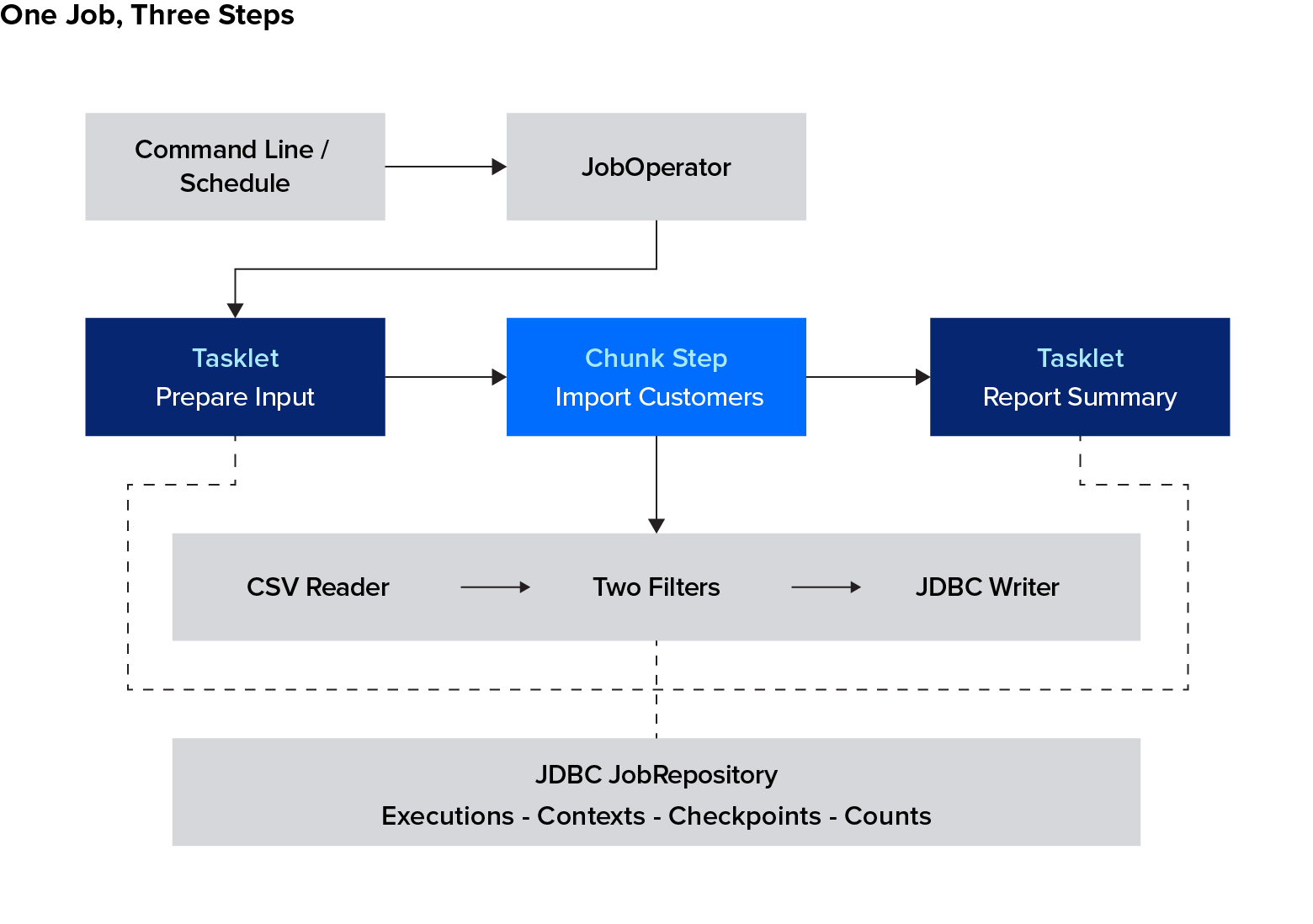
The job defines the sequence of operations. The JDBC repository data executions and restart state, and the author shops the chosen prospects in an software desk.
Configuring the Job and Step With JobBuilder and StepBuilder
The job definition specifies the step order and requires an enter path and report date. These bean definitions stay in a @Configuration class. The pattern challenge retains the linear job and its steps in CustomerJobConfiguration and places the scaling, conditional-flow, and scheduling variants in separate configuration courses, every activated by a Spring profile. The @Profile expression beneath selects this job when none of these variants is energetic:
@Bean
@Profile("!circulate & !partition & !parallel")
public Job customerReportJob(
    JobRepository repository,
    Step prepareInput,
    Step importCustomers,
    Step reportSummary) {

    return new JobBuilder("customerReportJob", repository)
        .validator(new DefaultJobParametersValidator(
            new String[]{"inputFile", "reportDate"},
            new String[]{"revision"}))
        .begin(prepareInput)
        .subsequent(importCustomers)
        .subsequent(reportSummary)
        .construct();
}
prepareInput validates the enter, importCustomers processes it, and reportSummary queries and logs the selected-customer rely. The import step is configured as follows:
@Bean
public Step importCustomers(
    JobRepository repository,
    PlatformTransactionManager tx,
    FlatFileItemReader<Buyer> customerReader,
    CompositeItemProcessor<Buyer, Buyer> customerProcessor,
    JdbcBatchItemWriter<Buyer> customerWriter,
    ObservationRegistry observations) {

    return new StepBuilder("importCustomers", repository)
        .<Buyer, Buyer>chunk(2)
        .transactionManager(tx)
        .reader(customerReader)
        .processor(customerProcessor)
        .author(customerWriter)
        .faultTolerant()
        .retry(TransientDataAccessException.class)
        .retryLimit(3)
        .skip(FlatFileParseException.class,
            InvalidCustomerException.class)
        .skipLimit(10)
        .skipListener(new BatchListeners.RejectLogger())
        .listener(new BatchListeners.StepSummary())
        .observationRegistry(observations)
        .construct();
}
The chunk measurement of two makes commits simple to examine with a small file. Select a manufacturing worth by means of measurement: Bigger chunks scale back commit frequency however improve the work that have to be rolled again after failure.
The trendy builders exchange the previous injected JobBuilderFactory and StepBuilderFactory. Discover the Spring Batch 6 type, .chunk(2).transactionManager(tx). It selects the brand new chunk implementation. The older .chunk(2, tx) overload is deprecated in 6.0. The specific transaction supervisor issues as a result of the author makes use of JDBC. Spring Batch 6 additionally reorganized packages, together with shifting merchandise APIs underneath org.springframework.batch.infrastructure.merchandise; use the pattern challenge’s imports when adapting older code.
The fault-tolerance and listener settings are included right here so the instance is runnable as offered. We are going to study their conduct beneath.
Sharing Information Between Steps With ExecutionContext
The preparation step must make the validated enter path out there to the import step. Spring Batch gives an ExecutionContext, a set of named values related to a job or step execution, for storing this type of state. Every step has its personal context; the job has one other context shared throughout its steps.
Placing a price right into a step context doesn’t robotically make it out there within the subsequent step. Use an ExecutionContextPromotionListener to advertise chosen values after profitable completion.
Our preparation step checks the enter file and data its path. The listener promotes that path into the job context:
@Bean
public Step prepareInput(
    JobRepository repository,
    PlatformTransactionManager tx) {

    var promotion = new ExecutionContextPromotionListener();
    promotion.setKeys(new String[]{"inputFile"});
    promotion.setStrict(true);

    return new StepBuilder("prepareInput", repository)
        .tasklet((contribution, context) -> {
            var step = contribution.getStepExecution();
            String enter = step.getJobParameters()
                .getString("inputFile");
            var useful resource = new FileSystemResource(enter);

            if (!useful resource.exists() || !useful resource.isReadable()) {
                throw new IllegalArgumentException(
                    "Can not learn enter file: " + enter);
            }

            step.getExecutionContext()
                .putString("inputFile", enter);

            return RepeatStatus.FINISHED;
        }, tx)
        .listener(promotion)
        .construct();
}
The reader will bind to that promoted inputFile worth when the import step begins. This easy instance demonstrates the mechanism with out including a file-download service. In a bigger pipeline, preparation might produce a validated staging-file path or an import identifier.
Maintain contexts small: Retailer paths, identifiers, and checkpoint values. Giant datasets belong in recordsdata or tables. Values should even be appropriate with the configured execution-context serializer.
Understanding @StepScope and @JobScope
The enter path and report date change into out there when a job runs. A @StepScope bean is created for a step execution, permitting its configuration to bind to these runtime values:
@Bean
@StepScope
public FlatFileItemReader<Buyer> customerReader(
    @Worth("#{jobExecutionContext['inputFile']}")
    String inputFile) {

    return readerFor(inputFile);
}
@JobScope gives a corresponding occasion for a job execution. Use a scope as a result of a part wants runtime state, fairly than including it to each bean. In partitioned work, every employee ought to have its personal step-scoped reader. Job-scoped beans have limitations in multithreaded and partitioned steps, so the scaling instance makes use of step scope for its reader, processor, and author.
Return a concrete reader or an interface exposing its ItemStream life cycle when defining a scoped reader bean. Spring Batch should be capable to name open, replace, and shut to handle its checkpoint state and sources.
Studying Information With ItemReader and FlatFileItemReader
ItemReader.learn() returns one merchandise at a time and returns null when enter is exhausted. FlatFileItemReader provides file studying and restart state; we provide the CSV mapping:
public static FlatFileItemReader<Buyer> readerFor(String inputFile) {
    return new FlatFileItemReaderBuilder<Buyer>()
        .title("customerReader")
        .useful resource(new FileSystemResource(inputFile))
        .strict(true)
        .linesToSkip(1)
        .delimited()
        .names("id", "title", "birthday", "transactions")
        .fieldSetMapper(fields -> new Buyer(
            fields.readLong("id"),
            fields.readString("title"),
            LocalDate.parse(fields.readString("birthday")),
            fields.readInt("transactions")))
        .construct();
}
The reader skips the header, parses 4 fields, and converts every row right into a Buyer. A malformed date turns into a FlatFileParseException, which the step’s skip coverage acknowledges. The reader’s steady title identifies its checkpoint entries.
Select a built-in reader that matches the supply:
FlatFileItemReader | Delimited or fixed-width textual content recordsdata, together with CSV |
JdbcCursorItemReader | A JDBC question consumed by means of a database cursor |
JpaPagingItemReader | JPA question outcomes retrieved a web page at a time |
A restartable reader additionally wants steady enter. Changing or reordering a CSV file between makes an attempt could make a saved row place level at completely different knowledge. Use an immutable file for every logical import.
Reworking Information With ItemProcessor and CompositeItemProcessor
The reader converts CSV rows into Buyer objects. We now must determine which prospects belong within the report: these whose birthdays fall within the report month and who’ve fewer than 5 accomplished transactions. An ItemProcessor applies enterprise guidelines between studying and writing, permitting us to validate, rework, or filter every merchandise earlier than it reaches the database.
We are going to use two processors to use the choice guidelines in sequence. The primary checks for invalid buyer knowledge, then passes by means of prospects whose birthday month matches the report month:
public class BirthdayFilterProcessor
    implements ItemProcessor<Buyer, Buyer> {

    non-public ultimate LocalDate reportDate;

    public BirthdayFilterProcessor(LocalDate reportDate) {
        this.reportDate = reportDate;
    }

    @Override
    public Buyer course of(Buyer buyer) {
        if (buyer.id() <= 0 || buyer.title().isBlank()
            || buyer.transactions() < 0) {
            throw new InvalidCustomerException(
                "Invalid buyer: " + buyer.id());
        }

        return buyer.birthday().getMonth() == reportDate.getMonth()
            ? buyer : null;
    }
}
An express reportDate retains the end result deterministic. A report restarted in October ought to nonetheless use September’s choice guidelines if it was initially a September run.
The second processor filters out prospects with 5 or extra accomplished transactions:
public class TransactionValidatingProcessor
    extends ValidatingItemProcessor<Buyer> {

    public TransactionValidatingProcessor(int restrict) {
        tremendous(buyer -> {
            if (buyer.transactions() >= restrict) {
                throw new ValidationException(
                    "Buyer has a minimum of " + restrict
                    + " transactions");
            }
        });

        setFilter(true);
    }
}
With setFilter(true), a validation failure turns into a filtered merchandise. A buyer with 5 or extra transactions is outdoors this report’s viewers. Invalid supply knowledge, similar to a unfavourable rely, as an alternative raises InvalidCustomerException within the first processor and is dealt with by the skip coverage.
CompositeItemProcessor runs the processors so as:
@Bean
@StepScope
public CompositeItemProcessor<Buyer, Buyer> customerProcessor(
    @Worth("#{jobParameters['reportDate']}") String reportDate) {

    var processor = new CompositeItemProcessor<Buyer, Buyer>();
    processor.setDelegates(Record.of(
        new BirthdayFilterProcessor(LocalDate.parse(reportDate)),
        new TransactionValidatingProcessor(5)));

    return processor;
}
Returning null filters an merchandise, so it doesn’t attain later delegates or the author. That is completely different from a processing failure recorded as a skip. The item-processing mannequin helps each filtering and transformation; a processor can even return a completely completely different output kind.
Writing Information With ItemWriter and JdbcBatchItemWriter
JdbcBatchItemWriter sends the chosen prospects to an software desk throughout the chunk transaction. On this challenge, buyer writes and repository updates use the identical knowledge supply and transaction supervisor, so the output and its checkpoint can commit collectively. Spring Batch 6 writers obtain the gadgets to jot down in a Chunk.
The desk makes use of the report date and buyer ID as its main key:
CREATE TABLE IF NOT EXISTS customer_report (
    report_date DATE NOT NULL,
    customer_id BIGINT NOT NULL,
    customer_name VARCHAR(120) NOT NULL,
    birthday DATE NOT NULL,
    transactions INTEGER NOT NULL,
    PRIMARY KEY (report_date, customer_id)
);
The author makes use of H2’s upsert syntax:
@Bean
@StepScope
public JdbcBatchItemWriter<Buyer> customerWriter(
    DataSource dataSource,
    @Worth("#{jobParameters['reportDate']}") String reportDate) {

    return new JdbcBatchItemWriterBuilder<Buyer>()
        .dataSource(dataSource)
        .sql("""
            MERGE INTO customer_report
            (report_date, customer_id, customer_name,
            birthday, transactions)
            KEY (report_date, customer_id) VALUES (?, ?, ?, ?, ?)
            """)
        .itemPreparedStatementSetter((buyer, assertion) -> {
            assertion.setDate(1, Date.valueOf(reportDate));
            assertion.setLong(2, buyer.id());
            assertion.setString(3, buyer.title());
            assertion.setDate(4, Date.valueOf(buyer.birthday()));
            assertion.setInt(5, buyer.transactions());
        })
        .construct();
}
MERGE ... KEY inserts a brand new row or updates the present row for that key. Reprocessing the identical buyer for a similar report subsequently doesn’t append a reproduction. That is H2-specific SQL; use your goal database’s equal and preserve the distinctive constraint. Additionally, an upsert doesn’t delete prospects who disappear from a revised enter. Changing a whole report snapshot requires an extra reconciliation technique.
Different built-in writers go well with completely different locations:
JdbcBatchItemWriter | Execute batched JDBC writes. |
FlatFileItemWriter | Write formatted data to a file. |
JpaItemWriter | Persist by means of JPA. |
CompositeItemWriter | Cross a bit to a number of delegate writers. |
A composite author doesn’t assure that writes to completely different methods succeed or roll again collectively. If one delegate writes to a database and one other calls an exterior API, design explicitly for partial failure and repeated supply.
Construct and run the challenge from its root listing. The instructions beneath use Bash-style line continuation ():
mvn clear confirm

java -jar goal/customer-batch-1.0.0.jar
    inputFile=enter/prospects.csv
    reportDate=2026-09-07
Job parameters use title=worth. Software settings use --name=worth, as documented in Boot’s command-line batch steerage.
The importCustomers step stories learn=5, filtered=2, written=2, and skipped=2. There are six enter data, however the unparseable line doesn’t rely as a profitable learn. The database comprises Ada and Diego for the report date.
Exception Dealing with, Retry, and Skip Methods
In manufacturing, many momentary failures come from infrastructure: timeouts, community interruptions, or a service that briefly can’t settle for work. When deciding whether or not to retry a failed operation, I contemplate whether or not one other try might succeed with out altering the enter. A request that timed out could succeed as soon as the service recovers; a malformed report will typically fail once more till the info is corrected. Each retries and skips want limits and monitoring.
Configuring Retry for Transient Errors
Retry settings belong on the step that performs the delicate operation, which in our job is importCustomers. To deal with momentary database failures there, we included the next settings in its configuration. TransientDataAccessException identifies database-access failures for which one other try could succeed:
.retry(TransientDataAccessException.class)
.retryLimit(3)
For the Spring Batch 6 chunk API used right here, retryLimit(3) permits three retries after the preliminary try. The take a look at suite verifies 4 failed author calls earlier than the step fails. If the author fails twice after which succeeds, the job completes. When a thrown exception wraps a transient trigger, the retry coverage can classify that trigger.
Maintain retry classes slim. An authorization failure or a completely invalid SQL assertion wants intervention. For distant calls, configure timeouts and a bounded backoff coverage, and set up whether or not retrying can repeat a facet impact. The JDBC instance has no distant service to name.
Configuring Skip Logic for Invalid Information
The pattern challenge tolerates malformed CSV and invalid buyer knowledge, as much as 10 skipped data within the step execution:
.skip(FlatFileParseException.class, InvalidCustomerException.class)
.skipLimit(10)
The eleventh invalid report fails the step. A skip restrict is a enterprise choice: Tolerating an incomplete advertising report could also be acceptable, whereas omitting a monetary transaction could require stopping the run.
Spring Batch 6.0.4’s default LimitCheckingExceptionHierarchySkipPolicy checks nested causes in addition to the thrown exception. When configuring one other skip coverage, confirm its classification conduct explicitly.
Infrastructure failures will not be skippable on this instance. Exhausting database retries subsequently fails the step fairly than silently discarding buyer output.
Dealing with Errors With Batch Listeners
Listeners make execution outcomes seen. A learn, course of, or write error callback stories an error throughout an try; a SkipListener stories a report that’s being skipped. These are completely different occasions when an operation is retried efficiently.
Our reject listener logs a CSV line quantity or buyer ID, avoiding uncooked buyer knowledge within the message:
public static class RejectLogger
    implements SkipListener<Buyer, Buyer> {

    @Override
    public void onSkipInRead(Throwable error) {
        if (error instanceof FlatFileParseException parseError) {
            log.warn("Rejected CSV line {} ({})",
                parseError.getLineNumber(),
                error.getClass().getSimpleName());
        }
    }

    @Override
    public void onSkipInProcess(Buyer buyer, Throwable error) {
        log.warn("Rejected buyer {} ({})", buyer.id(),
            error.getClass().getSimpleName());
    }
}
The step abstract logs counts and returns COMPLETED WITH SKIPS when a accomplished import has rejected data. An actual reject-management workflow ought to retain sufficient info to find and restore the enter, with entry and retention controls acceptable to the info. The instance’s log is a diagnostic help.
Listeners even have a boundary: They can not report a JVM crash after the method has disappeared. In my work, execution states and durations within the repository, along with metrics, are essential to discover a job that has stopped making progress. A lacking completion sign deserves consideration even when no listener recorded an error.
Controlling Job Circulate With Conditional Steps
Conditional circulate turns into helpful when the following operation is dependent upon an final result, similar to whether or not a accomplished import has rejected data that want overview. My very own manufacturing pipelines have largely adopted an easy sequence, so I introduce branching solely when a step’s end result genuinely adjustments what occurs subsequent.
The challenge’s circulate profile replaces the linear job with this definition:
@Bean
public Job customerReportJob(
    JobRepository repository,
    Step prepareInput,
    Step importCustomers,
    Step reviewRejects,
    Step reportSummary) {

    return new JobBuilder("customerReportJob", repository)
        .begin(prepareInput).on("COMPLETED").to(importCustomers)
        .from(prepareInput).on("*").fail()
        .from(importCustomers)
        .on("COMPLETED WITH SKIPS").to(reviewRejects)
        .from(importCustomers).on("COMPLETED").to(reportSummary)
        .from(importCustomers).on("*").fail()
        .from(reviewRejects).on("COMPLETED").to(reportSummary)
        .from(reviewRejects).on("*").fail()
        .finish().construct();
}
.on(...) matches a step’s ExitStatus code. A profitable import with skips goes to reviewRejects; a clear import goes on to reportSummary. The instance’s overview step units a flag within the job context. It leaves notification supply outdoors the tutorial.
The wildcard failure branches make surprising outcomes fail the job. A .fail() transition preserves failure semantics; utilizing .finish() on a failed department can mark the job full and forestall a standard restart. Spring’s flow-control documentation explains the excellence between framework BatchStatus and the ExitStatus used for routing.
For a call that wants its personal logic, similar to checking whether or not recent supply knowledge is accessible, use a JobExecutionDecider. Maintain easy exit-status routing readable earlier than introducing one other part.
Scaling Spring Batch for Excessive-volume Jobs
When the work inside a single job must run quicker, exhaust parallel processing inside one JVM earlier than shifting to preparations that span processes. Spring Batch helps a number of approaches inside a single course of, together with multithreaded steps and partitioning, which divides a step’s enter amongst staff. In my very own batch work I had many separate jobs to run, so I distributed complete jobs throughout a number of JVMs, every a separate Java course of, with coordination of the place and after they ran dealt with outdoors the person step definitions.
Begin by measuring the gradual a part of a consultant run. Verify database queries, indexes, connection availability, processor value, and chunk measurement earlier than rising concurrency. Further staff can’t compensate for a vacation spot that’s already saturated.
Multithreaded Steps
In Spring Batch 6, a multithreaded step runs merchandise processing concurrently whereas studying and writing keep serial, so the processor is the part that must be thread-safe. Within the pattern challenge, a Spring profile named parallel permits a multithreaded model of the shopper import step; a profile selects which configuration is loaded when the applying begins. This model provides the chunk step an executor to run merchandise processing on a number of threads:
@Bean
@Profile("parallel")
public Step parallelImport(
    JobRepository repository,
    PlatformTransactionManager tx,
    FlatFileItemReader<Buyer> customerReader,
    CompositeItemProcessor<Buyer, Buyer> customerProcessor,
    JdbcBatchItemWriter<Buyer> customerWriter,
    ThreadPoolTaskExecutor batchWorkers) {

    return new StepBuilder("parallelImport", repository)
        .<Buyer, Buyer>chunk(20).transactionManager(tx)
        .reader(customerReader)
        .processor(customerProcessor)
        .author(customerWriter)
        .taskExecutor(batchWorkers).construct();
}
This parallel instance makes use of the clear enter file, enter/customers-clean.csv. Its step has no retry or skip coverage, so invalid data fail the run. The pattern challenge’s README gives the command for working this model with its personal demonstration database.
The executor makes use of 4 staff and a queue that may maintain this instance’s 20-item chunk:
@Bean
public ThreadPoolTaskExecutor batchWorkers() {
    var executor = new ThreadPoolTaskExecutor();
    executor.setCorePoolSize(4);
    executor.setMaxPoolSize(4);
    executor.setQueueCapacity(20);
    executor.setThreadNamePrefix("batch-worker-");
    executor.setWaitForTasksToCompleteOnShutdown(true);
    return executor;
}
With this Spring Batch 6 implementation, processors run concurrently whereas studying and writing stay serial. The processor should subsequently be thread-safe. Our delegates use immutable configuration and preserve no altering per-item state. Their worker-thread calls additionally run outdoors the principle thread’s chunk transaction, so keep away from assuming a database operation inside a parallel processor shares that transaction.
Maintain executor capability aligned with submitted work. A queue that’s too small can reject duties even when the job’s knowledge is legitimate. The pattern challenge’s exams confirm precise concurrent processing in addition to the ultimate output.
Spring Batch 6 additionally provides native chunking, which delegates complete chunks to native staff. It requires the delegate to handle the chunk’s transactions and fault tolerance. Use it when that management matches the bottleneck. Parallel step flows are another choice when unbiased phases can run collectively. These scaling fashions have completely different state and transaction implications.
Partitioning Giant Workloads
Partitioning provides staff unbiased slices of enter and separate step executions. A database supply is perhaps divided into nonoverlapping ID ranges. For the file-based tutorial, the partition profile makes use of recordsdata which have already been break up into unbiased inputs.
The partitioner provides every employee’s file title by means of its step context:
@Bean
@Profile("partition")
@StepScope
public Partitioner filePartitioner(
    @Worth("#{jobParameters['inputFiles']}") String inputFiles) {

    return gridSize -> {
        Map<String, ExecutionContext> partitions =
            new LinkedHashMap<>();

        String[] paths = inputFiles.break up(",");

        for (int i = 0; i < paths.size; i++) {
            var context = new ExecutionContext();
            context.putString("fileName", paths[i].trim());
            partitions.put("file" + i, context);
        }

        return partitions;
    };
}
The supervisor connects these partitions to the employee step:
@Bean
@Profile("partition")
public Step partitionedImport(
    JobRepository repository,
    Step customerWorker,
    Partitioner filePartitioner,
    ThreadPoolTaskExecutor batchWorkers) {

    return new StepBuilder("partitionedImport", repository)
        .partitioner("customerWorker", filePartitioner)
        .step(customerWorker)
        .gridSize(4)
        .taskExecutor(batchWorkers)
        .construct();
}
Every employee makes use of a step-scoped reader certain to stepExecutionContext['fileName']. The exams course of two recordsdata, confirm separate employee executions, and verify that every one 100 take a look at prospects seem precisely as soon as within the output desk.
This instance runs staff inside one JVM. Distant partitioning locations employee steps in separate processes and provides communication and deployment configuration. Protect steady partition names and enter boundaries throughout a restart. A gridSize worth is a touch to the partitioner; our one-file-per-partition implementation returns as many partitions as file names, so executor capability should accommodate the submitted work.
Monitoring Jobs With Micrometer and JFR
Monitoring ought to inform us whether or not a job completed in time, produced the anticipated output, and is getting slower because the workload grows. Three alerts are significantly helpful:
- Completion time and standing: Verify that the job begins and finishes earlier than its outcomes are wanted. Examine job and step durations with earlier runs of an identical measurement. A job that is still energetic past its common period warrants investigation even when it has not reported a failure.
- Report counts: Examine data learn, filtered, skipped, and written with the anticipated enter and choice guidelines. A accomplished job can nonetheless produce an unexpectedly small report. Rising skip counts counsel issues with the supply knowledge; extra filtered data could merely replicate a unique buyer inhabitants.
- Processing charge: Observe what number of data the job handles per minute. If that charge falls for comparable enter, study the time spent studying, processing, and writing to slim down the place the slowdown happens.
The job repository shops execution standing, timestamps, and step counters, permitting us to analyze a selected run. Micrometer’s timing metrics cowl jobs, steps, and browse, course of, and write operations. Monitoring these metrics throughout runs helps reveal gradual slowdowns {that a} single profitable execution wouldn’t present.
Within the pattern challenge, the importCustomers step receives an ObservationRegistry, with Actuator offering the applying’s observability infrastructure. Exporting metrics to a monitoring service requires configuring an acceptable registry. Spring Batch 6 moreover emits Java Flight Recorder occasions, which may help examine execution conduct alongside JVM exercise. A neighborhood recording could be began with:
java
    -XX:StartFlightRecording=filename=batch.jfr,settings=profile
    -jar goal/customer-batch-1.0.0.jar
    inputFile=enter/prospects.csv
    reportDate=2026-09-09
Use recordings to analyze a selected efficiency query. Maintain operational alerts targeted on actionable situations, similar to a missed processing window or a rising reject rely.
Scheduling Spring Batch Jobs
I’ve used Spring’s @Scheduled annotation with ShedLock to forestall completely different software cases from executing the identical scheduled job concurrently. When a number of copies of an software are working, every can set off its personal scheduled methodology. ShedLock coordinates these copies by means of a shared lock: one occasion acquires it and runs the duty, whereas competing triggers skip execution for so long as the lock is held.
The rerun points I encountered had been largely associated to job parameters. A lock coordinates entry to the scheduled job; Spring Batch makes use of the job title and figuring out parameters to find out which work that job is requesting. These parameters should distinguish a brand new report from one other try to complete an current one. Scheduling subsequently includes each selecting when to launch and supplying parameters that determine the supposed work.
Working Jobs on a Cron Schedule
Use @Scheduled with a cron expression to launch the job, and set spring.batch.job.enabled=false so it doesn’t additionally run at startup. The pattern challenge’s scheduled profile demonstrates this in a single software course of. ShedLock integration can be an extra step for a deployment with a number of software cases.
The @Scheduled annotation beneath tells Spring to name runDailyReport() on daily basis at 02:00 UTC. That methodology asks JobOperator to launch the customer-report job with parameters for the present date:
@Scheduled(cron = "0 0 2 * * *", zone = "UTC")
public void runDailyReport() throws Exception {
    attempt {
        operator.begin(job,
            parametersFor(LocalDate.now(ZoneOffset.UTC)));
    } catch (JobInstanceAlreadyCompleteException
        | JobExecutionAlreadyRunningException ex) {
        log.data("Every day report already full or working");
    }
}
Spring’s cron expression has a seconds subject, so 0 0 2 * * * means 02:00 each day within the specified UTC zone. The launcher expects an immutable file named for that date. Make sure the file has arrived fully earlier than the set off, or make readiness a part of the launch course of.
When including ShedLock, configure a shared lock retailer and a lock period that covers the work being protected. If launching is asynchronous, coming back from the scheduling methodology can launch a lock whereas the batch job continues. An exterior scheduler or a container job is one other deployment possibility.
Guaranteeing Distinctive Job Situations
Use parameter values that determine the enterprise work:
public static JobParameters parametersFor(LocalDate date) {
    return new JobParametersBuilder()
        .addString("reportDate", date.toString())
        .addString("inputFile", "enter/customers-" + date + ".csv")
        .toJobParameters();
}
This produces the identical id for duplicate triggers on the identical date and a brand new id on the following date. All nodes should agree on these values and use the identical sturdy repository. Completely different path strings for a similar bodily file would produce completely different identities on this instance.
A timestamp or JobParametersIncrementer with startNextInstance can create new cases when each invocation genuinely represents new work. For a each day report, an arbitrary timestamp makes unintentional duplicate launches tougher to acknowledge and turns a retry into one other occasion. Protect the unique parameters when restarting a failed run.
Repository protections apply to the identical job occasion. They don’t forestall completely different cases from overlapping on the identical enterprise knowledge; coordinate that individually when overlap can be unsafe.
Constructing Restartable, Manufacturing-ready Batch Jobs
A protected restart wants each a dependable checkpoint and a vacation spot that tolerates repeated work. The challenge’s restart take a look at writes a bit, intentionally fails after writing the following chunk’s SQL, and checks that these uncommitted writes roll again. Restarting then reads and writes solely to the remaining prospects.
Spring Batch can restore a reader’s saved state when the identical occasion restarts. This is dependent upon a persistent repository, a stateful reader configured to avoid wasting its place, and unchanged enter. In our job, the finished preparation step is skipped on restart, whereas the promoted enter path stays out there.
I additionally use per-item identifiers to make repeated processing protected. Relying on the supply, that identifier is perhaps a URL, URI, file title, or one other steady enterprise key. The verify and write have to be protected collectively: A separate “already processed?” question adopted by an insert can nonetheless race with one other employee. Right here, the database key and upsert implement the supposed conduct.
For exterior negative effects, outline an idempotency key or use a transactional outbox. A database rollback can’t unsend an HTTP request or an e mail. Maintain these boundaries express when extending the instance.
A tough course of failure wants extra operational dealing with as a result of repository standing could stay STARTED. Spring Batch 6 gives JobOperator.get well for recovering stale execution state. First set up that the unique execution is now not working, then reconcile any unsure exterior results earlier than restoration and restart. Don’t change figuring out parameters merely to bypass a caught execution.
Testing Spring Batch Jobs
The toughest batch exams are sometimes partial failures and restarts. A COMPLETED standing alone can’t set up that the fitting rows had been written, a failed chunk rolled again, or rejected enter stayed inside coverage.
The spring-boot-starter-test dependency in our pom.xml provides the testing libraries, with Spring Boot 4.0.7 choosing JUnit Jupiter 6.0.3. Boot manages that model alongside the opposite dependencies, so we don’t must specify a separate JUnit model. Jupiter gives the annotations and execution engine for our exams: @Check marks a take a look at methodology, and @BeforeEach marks setup code to run earlier than every take a look at. Each annotations come from org.junit.jupiter.api.
For exams that train the batch software, annotate the take a look at class with @SpringBootTest and @SpringBatchTest. @SpringBootTest masses the applying’s Spring configuration and integrates Jupiter with Spring, permitting the take a look at to obtain beans by means of dependency injection. @SpringBatchTest provides utilities for launching jobs and steps and dealing with batch execution contexts.
In Spring Batch 6, we inject JobOperatorTestUtils, named jobs within the take a look at beneath. Its startJob methodology runs the entire job; startStep runs a person step. The assertThat checks use AssertJ, additionally provided by the take a look at starter, to match the precise outcomes with the anticipated values.
This take a look at checks the total job’s outputs and counters:
@Check
void filtersBusinessExclusionsAndSkipsInvalidRecords()
    throws Exception {

    var end result = jobs.startJob(
        parameters(Path.of("enter/prospects.csv")));

    assertThat(end result.getStatus())
        .isEqualTo(BatchStatus.COMPLETED);

    var step = end result.getStepExecutions().stream()
        .filter(s -> s.getStepName().equals("importCustomers"))
        .findFirst()
        .orElseThrow();

    assertThat(step.getReadCount()).isEqualTo(5);
    assertThat(step.getFilterCount()).isEqualTo(2);
    assertThat(step.getReadSkipCount()).isEqualTo(1);
    assertThat(step.getProcessSkipCount()).isEqualTo(1);
    assertThat(step.getWriteCount()).isEqualTo(2);

    assertThat(jdbc.queryForList(
        "SELECT customer_id FROM customer_report ORDER BY customer_id",
        Lengthy.class))
        .containsExactly(1L, 4L);

    assertThat(repository.getJobExecution(end result.getId())
        .getExecutionContext()
        .getString("inputFile"))
        .endsWith("prospects.csv");
}
The encircling take a look at class injects JobOperatorTestUtils, JobRepository, and JdbcTemplate. It clears the take a look at database between instances and disables startup execution, so the take a look at controls when a job begins.
The ultimate assertion reads the saved job context by means of JobRepository and checks that the preparation step promoted the enter path. This verifies that the enter path was saved within the job context the place later steps can retrieve it.
A person step take a look at should present any context usually provided by previous steps:
@Check
void testsTheImportStepWithItsRequiredJobContext() throws Exception {
    Path enter = prospects(2);
    var context = new ExecutionContext();
    context.putString("inputFile", enter.toString());

    var end result = jobs.startStep(
        "importCustomers", parameters(enter), context);

    assertThat(end result.getStatus())
        .isEqualTo(BatchStatus.COMPLETED);

    assertThat(jdbc.queryForObject(
        "SELECT COUNT(*) FROM customer_report", Lengthy.class))
        .isEqualTo(2);
}
For a scoped part in isolation, use StepScopeTestUtils to determine the execution context and name the reader’s life-cycle strategies:
@Check
void readerBindsToThePromotedFileAndClosesItsStream() throws Exception {
    var step = MetaDataInstanceFactory.createStepExecution(
        new JobParametersBuilder()
            .addString("reportDate", "2026-09-07")
            .toJobParameters());

    step.getJobExecution().getExecutionContext().putString(
        "inputFile",
        Path.of("enter/prospects.csv").toAbsolutePath().toString());

    Lengthy firstId = StepScopeTestUtils.doInStepScope(step, () -> {
        customerReader.open(step.getExecutionContext());
        attempt {
            return customerReader.learn().id();
        } lastly {
            customerReader.shut();
        }
    });

    assertThat(firstId).isEqualTo(1L);
}
These utilities are coated within the Spring Batch testing information. The pattern challenge provides failure-injection exams for retries, skip limits, rollback, and restart, plus conditional-flow and concurrency exams. Its 19 exams cross towards the pinned dependency set.
Earlier than deployment, run equal exams towards the supposed database and lifelike supply knowledge. H2 validates this tutorial’s conduct; it doesn’t set up the locking, SQL dialect, or throughput traits of one other database. Distributed scheduling and distant partitioning additionally want their very own integration exams.
Placing Spring Batch to Work
The client report now has an express enter, deterministic choice guidelines, transactional output, and examined restoration conduct. That provides us a basis for including extra demanding sources, processing, or supply necessities.
To your personal job, determine what identifies a run, which failures deserve one other try, and what proof will present {that a} restart was protected. These selections will form the implementation greater than the scale of the primary enter file. As necessities develop, skilled Spring programmers may help lengthen the design whereas sustaining predictable restoration conduct.
Studying Assets for Spring Batch
Begin with the reference documentation and the challenge’s personal samples, as a result of a lot of the printed books on Spring Batch describe earlier variations of the framework. Spring Batch in Motion (2011) covers model 2, and Michael Minella’s The Definitive Information to Spring Batch (2019) covers model 4. Each are nonetheless value studying for the ideas this tutorial makes use of, together with chunk processing, restartability, and partitioning, which have been steady throughout releases. Their configuration APIs have since modified, so learn the code for the design and make sure the present syntax earlier than adapting it.
Seek the advice of the next sources for materials that tracks the model you’re working: