Andrej Karpathy sees a widening hole in how folks see LLM capabilities.
Most people has largely not interacted with these techniques. Once they have, it appears like a derpy chatbot. The vast majority of professionals nonetheless see solely a modest uplift. And a small sliver of pros are experiencing the vertigo of the curve going vertical. And it’s all occurring on the similar time.
Lots of my colleagues reside in a world the place LLM capabilities are gorgeous, but it surely’s simple to overlook that’s not what most individuals expertise. One factor I do is use free-tier LLM chatbots, and I’m nonetheless discovering that whereas more often than not they’re helpful, their unreliability undermines a lot of that usefulness. Sure, you possibly can argue that I’m not utilizing frontier instruments or a forceful sufficient harness, however that’s true of most common of us too. To know their notion, it’s useful to expertise it.
❄ ❄ ❄ ❄ ❄
That statement notably resonates with me at this time, as I’ve simply spent the weekend at Foocamp, an open house occasion run by O’Reilly. It was filled with those that are experiencing that vertigo of LLM capabilities, so it felt very very similar to being in a bubble of these on the bleeding edge. Whereas it’s price remembering that that’s not a typical view of what’s occurring, it’s good to see what these explorers are experiencing. (As I discuss this, I’m making use of the Chatham Home rule, if anybody desires attribution, let me know.)
A few of us talked about doing immersion programs to assist educate builders the best way to do agentic engineering. The thought is to get folks out of their common work setting, and spend one or two weeks with skilled coaches, studying the best way to use these instruments nicely. Such issues remind me very a lot of the Excessive Programming immersion lessons I used to be concerned with on the flip of the century. As with that, the expertise of constructing one thing is vital to know such a brand new model of labor.
Unsurprisingly the coaches noticed that the largest impression wasn’t technical, however emotional. New instruments are simply new instruments, however these instruments change fundamental assumptions of what it means to be a software program developer, which for many individuals challenges their identification. One coach mentioned how his important job was to take such folks out for a stroll to a espresso store, so they might course of what’s occurring. (This jogs my memory of a participant of the Excessive Programming immersion who was so horrified by means of a non-locking version-control system (CVS) that he walked out of the category on the primary day.)
❄ ❄
I’m cautious of speaking about themes to an occasion the place I attend lower than one-tenth of the classes, however a subject I stored coming throughout was how giant enterprises have been embracing this know-how – or somewhat not. One participant used a stunning metaphor: firms have acquired a Swiss-army knife, however are solely utilizing the toothpick. I see loads of respectable causes for this: it’s one factor for a startup or particular person to make use of a sizzling know-how, however there’s an enormous distinction between an internet site taking place and your factories grinding to a halt. Huge organizations contain workflows involving plenty of folks that have constructed up over a few years – they don’t change simply. Safety considerations abound, the deadly trifecta nonetheless lurks.
Specifically good use of AI in enterprises depends on good information, and lots of such organizations don’t have their information in a good form. The path to getting agent-ready information isn’t trivial and it’s exhausting to see how we are able to get the knife and noticed out till enterprises are a lot additional down that path. One factor that struck me is that there was little dialog about this at Foocamp – an indication of its visibility among the many folks there.
❄ ❄
I very a lot loved Foocamp, however occasions like this are all the time a mixture of pleasure and dread. I knew only a few of the folks there, so it was a terrific alternative to get out of my very own social bubble. However I additionally discover it practically inconceivable to stroll as much as folks I don’t know (or know barely) and impose my firm on them. The wonderful thing about unconferences is that the character of the classes make it believable for somebody like me to have interaction in dialog throughout them, and start some tentative hyperlinks. Additionally I thank the numerous of us there who have been pleasant to me as I casually walked round making an attempt to cover how a lot I used to be panicking.
❄ ❄ ❄ ❄ ❄
Laurie Voss says at this time is 1997
On Saturday, Apollo’s chief economist Torsten Slok revealed No Indicators of AI Payoff Outdoors the Tech Sector. It’s brief and it’s blunt: exterior of seven main tech firms, there is no such thing as a information but to assist a productiveness acquire that justifies all the cash pouring into tech.
My place is that he’s half proper: are valuations too excessive? Completely. We’re in a bubble, and it’s completely going to pop. However does that imply investing in AI is a waste of cash? Completely not, and utilizing this early information to attempt to resolve that query can be like making an attempt to resolve in 1997 whether or not the Web was going to repay. The info simply isn’t there but, as a result of this stuff take time.
I’m not as positive as he’s that we are able to peg at this time to 1997 somewhat than 1999, however I agree that this growth bears loads of resemblance to the dotcom growth (though I feel this one is greater). Whereas many dotcom firms crashed (I all the time consider pets.com and webvan) he’s proper to level out that anybody who invested in Amazon in 1997 did very nicely. The place would possibly these good investments be this time?
in case you can construct one thing that proves you bought the reply, AI can get the reply a lot quicker than you possibly can, and there are actual productiveness positive aspects available doing that typically.
As we take into consideration this, do not forget that funding isn’t simply shopping for shares, but additionally the place we select to take a position that treasured useful resource of our time and vitality.
❄ ❄ ❄ ❄ ❄
Adam Tornhill asks Had been All These Years of Coding Wasted?
For me, agentic coding is gratifying as a result of it lets me tackle bigger elements of an issue than I might have been capable of grasp manually. Infrastructure updates are now not a blocker. And I don’t must spend time studying a couple of construct system I by no means cared about.
My private purpose is to get higher at working with higher-level abstractions, and settle for that writing code is more likely to be a dying ability. My wager on the longer term is that our downside fixing abilities, logical mindset, and understanding of techniques might be not less than as rewarding.
In the long run, we solely must problem our identification if we mistake programming for writing code. AI lastly permits us to separate the 2. And that’s the place all these years of expertise switch the perfect: understanding not solely what to construct however the best way to construct it nicely.
❄ ❄
Tim Bray appears at this from one other route
For me (and I’m not alone), the largest difficulty isn’t what GenAI can and might’t do, it’s the moral and financial discomforts. This know-how is being peddled by horrible people who find themselves wealthy and whose purpose is to get richer. It’s purchased and deployed by horrible individuals who need to slash their payrolls by throwing thought employees onto the road. It facilitates the oncoming local weather disaster and devalues human inventive effort.
❄ ❄ ❄ ❄ ❄
Annie Vella observes that the change we’re seeing in software program improvement follows a mind-set about automation that goes again to the 1960’s as the excellence between direct and supervisory management.
The principle distinction between direct and supervisory management is that within the latter, there’s a pc that closes the loop as an alternative of a human operator. Earlier than AI, writing software program was far more like direct management – we closed the loop ourselves. We interpreted necessities, made adjustments to the code, obtained suggestions and acted on it, again and again. Now, coding brokers can more and more shut that loop themselves – writing code, working exams and fixing their very own errors – whereas we transfer in direction of supervisory management: telling the agent what we wish, keeping track of the way it’s going and taking on when we have to.
She outlines numerous concepts that this mental thread developed. The five-level mannequin developed by Endsley and Kiris appears apposite:
| Degree | Human | System | In AI-assisted software program improvement |
|---|---|---|---|
| 1. None | Determine, act | – | No AI help |
| 2. Choice assist | Determine, act | Counsel | The early days of AI coding assistants’ autocomplete |
| 3. Consensual AI | Concur | Determine, act | AI coding brokers the place it’s essential to approve the actions they take |
| 4. Monitored AI | Veto | Determine, act | Auto-mode, with the power to veto the coding agent’s actions |
| 5. Full automation | – | Determine, act | Full auto-mode, corresponding to is perhaps utilized in a darkish software program manufacturing facility |
Vella cautions that this comes with an vital caveat:
There’s one notable distinction between the automation described by this prior analysis and the kind of automation that AI brokers give us. Each units of ranges assume that the pc’s account of what it did is correct and trustworthy. As everyone knows by now, what an AI agent says it did and what it really did is probably not the identical factor. Nonetheless, it’s automation, and it nonetheless requires supervision – arguably extra, since we are able to’t merely take its phrase for it.
Vella’s conclusion from all that is that: “our subsequent step have to be to start out redesigning the job and the system, in tandem”. I agree with this, and the Foocampers’ immersion programs I discussed earlier are a part of that train. The difficult factor is that we don’t but know what this new job design appears like, however I feel Vella is on the correct path when she says:
What if we stopped pondering of the SDLC as a course of we observe, and as an alternative began pondering of it as a management system we construct and supervise?
❄ ❄ ❄ ❄ ❄
Some time in the past I discussed how a lot I loved Eric Evans’s keynote at DDD Europe. Now the video is offered so those that weren’t in Antwerp can watch it.
He opens by our future, saying that somewhat than fruitlessly making an attempt to foretell it, we must always as an alternative discover it with “curiosity, enjoyable, and marvel”. He’s been doing this, digging deeper into the idea and fundamentals that underpin AI.
He goes into element on his facet challenge: the Area Language Surveyor. The thought is to have the ability to look at completely different repositories, and analyze the vocabulary used inside these repositories to see if they’re associated bounded contexts. To do that he constructed a pipeline of instruments, illustrating how a helpful system blends each computational and inferential parts. He then used this pipeline to investigate the vocabulary of some open-source healthcare codebases, to see how their bounded contexts associated.
❄ ❄ ❄ ❄ ❄
A subject that repeatedly comes up once I discuss to firms exterior the Foocamp world, is the price of tokens, and the priority about how that value goes to extend sooner or later. We’ve been worrying about that at Thoughtworks, and my colleague Andy Nolan describes our token sourcing technique, which we forecast will cut back our token prices in 2028 from $16-40M all the way down to $6.8-1M.
The technique rents frontier fashions for the work that wants frontier-level reasoning. It runs open-weight fashions, on capability we select, for the work that carries our IP or runs at a quantity the place proudly owning the capability prices much less.
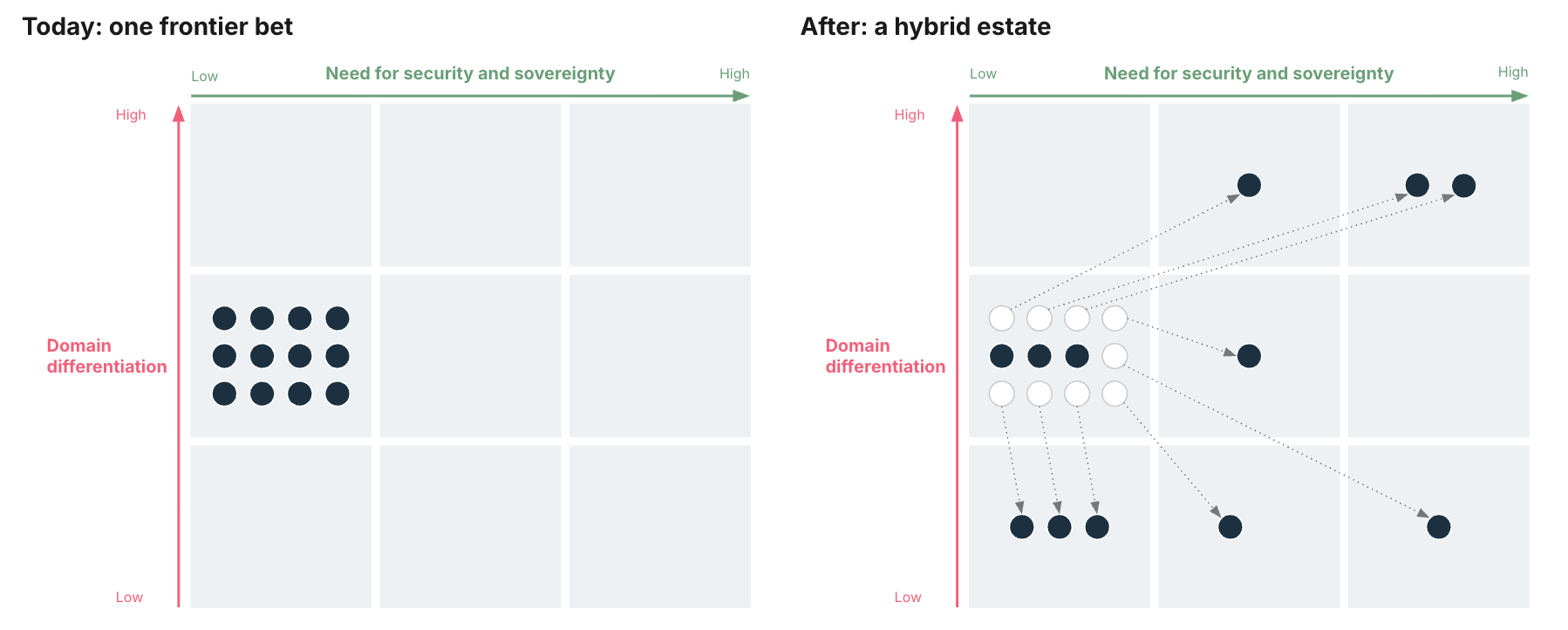
The technique entails every LLM workload, and classifying it on two axes: area differentiation and safety & sovereignty. We then place every workload on a 9 cell grid.
The 9 cells run from the most affordable succesful API, swapped as costs change, to a fine-tuned open mannequin on our personal infrastructure, with full management and full maintenance. For a given workload, the best rating on a given axis determines the correct place within the grid. There isn’t any single proper place for all workloads. Every group finally ends up with its personal distribution and mixture of workloads throughout the grid.