
Each fee, switch, and commerce in a fintech product passes via a transaction processing system (TPS). A buyer retries a fee after a timeout. The financial institution has already processed it, however the utility by no means acquired affirmation. Ought to the system retry or wait? The flawed choice may result in a reproduction cost.
For fintech groups, such failures imply monetary discrepancies, handbook investigations, and tough questions on the place the cash went. This text explains how transaction processing works, which architectural decisions matter, and the best way to shield monetary operations from failures.
Key Takeaways
- A TPS should protect transaction information, forestall duplicate execution, and recuperate unsure outcomes when networks or suppliers fail.
- Idempotency keys forestall duplicate fees when shoppers or suppliers retry requests.
- A timeout doesn’t imply a failure: the system should test the true standing earlier than retrying.
- A double-entry ledger makes each steadiness change traceable and simple to audit.
- Each day reconciliation towards financial institution and supplier information finds the errors that code alone can not forestall.
What Is a Transaction Processing System?
A transaction processing system (TPS) is software program that processes enterprise operations and information their outcomes. In fintech, it serves because the fee processing system that handles funds, transfers, and trades, making certain that every operation has a traceable standing and that monetary information stay correct.

In software program phrases, the TPS which means is a system of report for occasions that should finish in a recognized remaining state. Transaction processing (TP) programs of this sort are additionally described as a transaction info system or TPS info system, and most are constructed as on-line transaction processing (OLTP) programs that deal with many quick, concurrent operations in actual time.
For instance, when a buyer transfers cash, the TPS should confirm the request and report the ensuing steadiness adjustments. If a connection fails, the system should decide whether or not the operation succeeded earlier than making an attempt it once more.
ACID Properties in Transaction Processing
On the database degree, transaction integrity depends on 4 ACID properties:
- Atomicity: All adjustments inside a transaction are dedicated collectively, or none take impact.
- Consistency: Every dedicated transaction preserves the database’s integrity guidelines.
- Isolation: Concurrent transactions observe outlined isolation ensures with out exposing uncommitted adjustments.
- Sturdiness: Dedicated adjustments stay saved after a system failure.
Nevertheless, ACID applies to database transactions, not essentially to a whole fee workflow. When a number of providers or exterior suppliers are concerned, further mechanisms are wanted to forestall duplicate operations and resolve unsure outcomes.
TPS vs Analytical Techniques
Transaction processing and analytical programs serve completely different functions. A TPS, usually operating as an OLTP system, handles frequent updates, whereas analytical programs course of historic information to establish patterns and produce reviews. Determination assist programs (DSS) and administration info programs (MIS) belong to this group: they use information recorded by a TPS however don’t execute transactions.
Working advanced analytical queries on a stay transactional database can enhance competition and decelerate funds. Subsequently, fintech platforms usually separate these workloads to guard transaction processing efficiency.
| Criterion | Transaction Processing System | Analytical System |
| Function | Execute and report operations | Analyze enterprise efficiency |
| Knowledge | Present transaction information | Historic and aggregated information |
| Pace | Prioritizes low-latency processing | Handles longer analytical queries |
| Typical customers | Fee providers, banking functions, operators | Analysts, finance groups, administration |
| Examples | Fee processing, order execution | Income reviews, transaction pattern evaluation |
Forms of Transaction Processing Techniques
Transaction processing programs, or TPS programs, fall into three major varieties: real-time, batch, and hybrid. The distinction lies in when operations are executed, how shortly their outcomes turn out to be obtainable, and what occurs when processing is interrupted.
| Kind | How It Works | Typical Use | Primary Threat |
| Actual-Time (On-line) | Processes every transaction because it arrives and returns a right away consequence. | Card authorization, pockets transfers, ATM withdrawals | Supplier timeouts or community failures can go away transaction outcomes unsure. |
| Batch | Collects transactions and processes them collectively at scheduled intervals. | Payroll runs, bulk financial institution transfers, recurring funds | A failed batch can delay many funds and make particular person errors tougher to establish. |
| Hybrid | Combines fast transaction processing with scheduled clearing, settlement, or reconciliation. | Card funds with real-time authorization and subsequent batch settlement | Completely different processing levels can report conflicting statuses or quantities. |
Most fee programs use a hybrid method. A card transaction could also be licensed in actual time, whereas clearing, settlement, and reconciliation observe separate schedules, usually involving batch processing. The TPS should observe these levels independently moderately than treating authorization as proof that the funds have settled.
From Our Apply
In SCAND’s SEPA compliance middleware undertaking, a European financial institution acquired fee directions in giant batch recordsdata. The middleware cut up every batch into particular person transfers for AML screening whereas preserving the unique batch context, permitting the financial institution to guage funds individually with out shedding their relationship to the supply file.
Transaction Processing System Examples
Frequent TPS system examples in fintech embody card funds, financial institution transfers, e-wallet top-ups, and buying and selling orders. In every instance transaction processing system, the query is similar: what counts as full? The desk under exhibits what a TPS information in every case and when the operation will be handled as completed.
| Instance | What the TPS information | What “full” means |
| Card fee | Authorization, seize, charges, settlement standing | Fee captured and settlement confirmed |
| Financial institution switch (SEPA/ACH) | Switch instruction, financial institution acknowledgments, account actions | Funds credited to the beneficiary, with remaining standing confirmed |
| E-wallet top-up | Funding transaction, ledger entries, pockets steadiness | Pockets credited in response to funding and settlement guidelines |
| E-commerce order | Order standing, fee affirmation, stock reservation | Fee and required order-processing steps accomplished |
| Buying and selling order | Order submission, executions, fills, positions | Execution accomplished; clearing and settlement tracked individually |
| Payroll run | Wage calculations, fee directions, switch outcomes | Funds confirmed and accounting information reconciled |
Why Transaction Statuses Matter
A standard reporting mistake is treating licensed, captured, and settled as the identical standing. Authorization confirms {that a} card fee is accredited, seize requests the gathering of funds, and settlement completes the related monetary switch. Every stage wants its personal report.
Cross-border funds illustrate one other threat. In response to SWIFT, 75% of transactions over its community attain the vacation spot financial institution inside 10 minutes, but the receiving financial institution should want to finish native processing earlier than crediting the beneficiary.
For a TPS, arrival on the vacation spot financial institution is subsequently an intermediate milestone, not proof of accomplished fee. Marking such a switch as profitable too early distorts reviews and complicates buyer assist, so a fintech TPS ought to observe intermediate states, report exterior confirmations, and distinguish profitable message supply from accomplished fee processing.
How a Transaction Processing System Works: The Transaction Lifecycle
The method of transaction processing system execution follows a sequence of state adjustments, from receiving a request to confirming its monetary consequence. Contemplate a buyer paying €100 for a web-based order. Even when the acquisition seems profitable, a number of steps should occur earlier than the service provider can affirm that the cash has been settled.
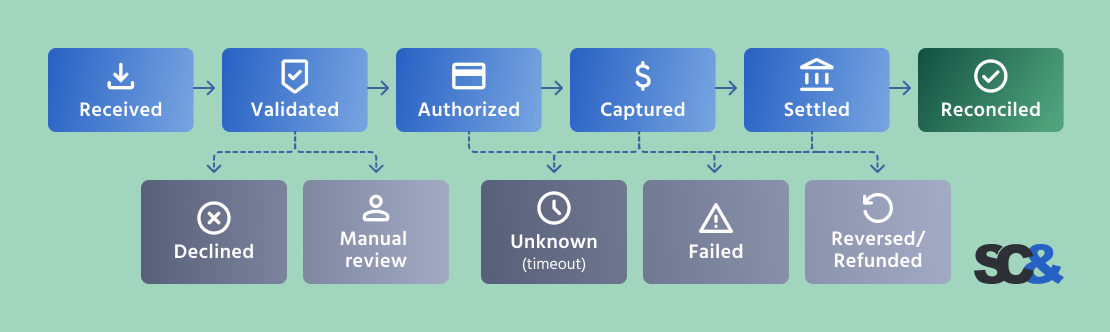
- Acquired. The client clicks “Pay,” and the TPS registers the request with a novel transaction identifier. If the connection drops and the client tries once more, the system should acknowledge the unique fee to keep away from duplicate fees.
- Validated. Earlier than contacting the financial institution, the platform checks the fee particulars and relevant compliance guidelines. Relying on the outcomes, the request can proceed, be declined, or enter handbook evaluation if further investigation is required.
- Approved. Subsequent, the issuing financial institution approves or declines the fee. For instance, inadequate funds might result in a decline, whereas an accredited authorization permits the service provider to proceed with out confirming remaining settlement.
- Captured. As soon as the order is prepared for processing, the service provider requests seize towards the authorization. An expired authorization or incorrect seize quantity can forestall the fee from shifting ahead.
- Settled. The captured fee enters the relevant clearing and settlement course of. Nevertheless, the service provider should be ready for funds or remaining affirmation, despite the fact that the client has already acquired an order affirmation.
- Reconciled. Later, the finance system compares inside fee information with the supplier’s settlement report. Any lacking transaction, sudden price, or quantity mismatch turns into an exception requiring investigation moderately than an unnoticed accounting error.
Dealing with Various Transaction States
Not each fee follows the profitable path. Relying on the place the issue happens, the TPS should distinguish between a number of outcomes:
- Declined: The request fails validation, or the issuing financial institution refuses authorization.
- Failed: A technical or processing error prevents a step from finishing.
- Unknown: A timeout leaves the precise consequence unconfirmed.
- Reversed / Refunded: An authorization is launched or a separate refund returns funds after seize or settlement, relying on the fee circulate.
The unknown state is especially harmful. If the financial institution processes the €100 cost however its response by no means arrives, instantly repeating the request may cost the client twice. As an alternative, the TPS should confirm the unique transaction’s standing earlier than taking additional motion.
Transaction Processing System Structure for Fintech
A fintech TPS should coordinate fee execution throughout inside providers and exterior suppliers with out shedding observe of transaction states. The principle architectural problem is holding monetary information constant when a request fails, a supplier occasions out, or a service turns into unavailable.
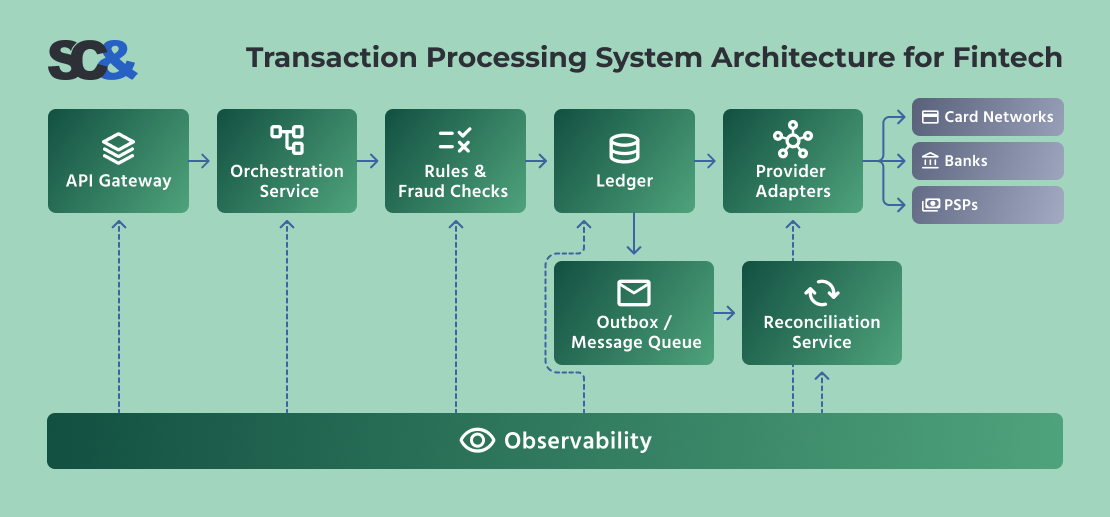
Every element addresses a selected processing threat. The desk exhibits how these obligations are divided and what can occur when the corresponding controls are lacking.
| Part | What It Does | What Can Go Incorrect With out It |
| API Gateway | Authenticates requests, validates inputs, and controls site visitors. | Invalid requests or site visitors spikes can overwhelm fee providers. |
| Orchestration Service | Coordinates processing steps and tracks transaction states. | Funds might stay unfinished or set off duplicate supplier calls. |
| Guidelines and Fraud Checks | Evaluates transaction limits, fraud dangers, and compliance necessities. | Suspicious or unauthorized operations might attain execution. |
| Ledger | Data monetary actions and maintains account balances. | Inner balances might disagree with precise monetary exercise. |
| Supplier Adapters | Connects the TPS to banks, card networks, and PSPs via APIs. Our fee gateway integration experience and API growth providers cowl these connections. See additionally the best way to combine a fee gateway. | Inconsistent supplier responses may cause failed requests or incorrect transaction statuses. |
| Outbox / Message Queue | Data and delivers transaction occasions to downstream providers. | A fee could also be dedicated with out notifying different programs. |
| Reconciliation Service | Matches inside information towards exterior statements and settlement reviews. | Lacking funds or incorrect quantities might go undetected. |
| Observability | Tracks transaction exercise via logs, metrics, and distributed traces. | Engineers can not reliably find failures or examine caught transactions. |
Centralized vs Distributed Structure
A system with a shared transactional database simplifies atomic updates and debugging. Distributed providers can scale independently, however sustaining consistency throughout them requires further mechanisms.
For instance, a SAGA coordinates multi-service operations and their compensating actions, whereas a transactional outbox helps forestall misplaced occasions. Neither removes the necessity for idempotency.
The architectural alternative ought to mirror precise transaction quantity, integration complexity, and failure necessities. Splitting a TPS into microservices too early can introduce consistency issues {that a} centralized design would keep away from. See the challenges of microservice structure.
From Our Apply
In our SEPA compliance middleware undertaking, SCAND used Apache Kafka for payment-message ingestion and sharded MongoDB to retailer screening outcomes for auditing and reporting. Energetic-active failover is an structure through which a number of situations course of site visitors concurrently, permitting operations to proceed throughout upkeep or native {hardware} failures. The answer supported SaaS and on-premises deployment.
Engineering for Correctness: How you can Keep away from Misplaced and Duplicate Transactions
The most expensive TPS failures usually occur between providers moderately than inside enterprise logic: a consumer retries a request, a financial institution stops responding, or a message fails to succeed in its vacation spot after a database replace. Every occasion raises the identical query: what truly occurred, and the way can the system keep away from shifting cash twice? Idempotency, coordination patterns, and monetary controls reply it collectively.
Idempotency and Idempotency Keys
Idempotency is the property that repeating an operation produces no further results past its first execution. An idempotency secret is a novel identifier that lets a server acknowledge repeated requests for a similar enterprise operation.
Think about a buyer paying €100 on-line. The financial institution processes the cost, however the connection drops earlier than affirmation arrives, and the client clicks “Pay” once more. An idempotent fee API handles this as follows:
POST /funds
Idempotency-Key: pay-order-847
- The consumer submits a fee request with a novel key.
- The server reserves the important thing and associates it with the transaction.
- The fee executes, however the response is misplaced.
- The consumer retries with the identical key and receives the unique consequence or present standing, with out a second fee.
For this mechanism to work, the server should retailer the important thing alongside the request parameters and transaction consequence. Concurrent retries additionally want safety, whereas reusing a key with completely different parameters ought to set off an error.
How lengthy ought to keys be retained? The reply depends upon the retry window and fee workflow. For reference, Stripe paperwork a minimal retention interval of 24 hours for its API idempotency keys. Inner transaction identifiers might have to stay obtainable for much longer.
Importantly, native idempotency doesn’t routinely forestall duplication at an exterior financial institution. The TPS should additionally protect supplier references and respect the supplier’s retry guidelines.
Timeouts and Unknown States
Idempotency addresses repeated requests, however the TPS should not know whether or not an exterior supplier accomplished the unique fee. A financial institution might course of a switch whereas its response disappears, so the cash might have already got moved.
A timeout should subsequently produce an unknown state, not an automated failure. The TPS retains the unique transaction reference, queries the supplier’s standing API or waits for a verified webhook, and solely then decides whether or not to retry, cancel, or escalate. In any other case, restoration might create the duplicate cost it was meant to forestall.
Consistency Throughout Providers: 2PC, SAGA, and Transactional Outbox
A fee supplier might report profitable assortment whereas the order service fails earlier than confirming the acquisition. Database transactions can not undo actions carried out by unbiased suppliers, so distributed programs want further coordination.
- Two-phase commit (2PC) is a protocol that asks collaborating transactional assets to organize adjustments earlier than coordinating their remaining commit or rollback.
- A SAGA is a sequence of native transactions that makes use of compensating actions when later steps fail.
- A transactional outbox is a sample that shops an outgoing occasion in the identical database transaction because the corresponding enterprise replace, permitting the occasion to be revealed afterward.
| Sample | How It Works | When to Use | Commerce-off |
| 2PC | Members put together adjustments earlier than a coordinated commit. | Databases supporting distributed transactions | Coordination overhead and potential blocking |
| SAGA | Native transactions execute individually, with compensation after failures. | Multi-service workflows | Extra advanced state dealing with and compensation |
| Transactional Outbox | Enterprise adjustments and outgoing occasions are saved atomically. | Dependable occasion supply between providers | Customers should deal with duplicate occasions |
For exterior banks and suppliers, 2PC is mostly unavailable, so a SAGA coordinates the workflow whereas an outbox preserves the occasions downstream providers should obtain. If fee assortment succeeds however achievement fails, the SAGA might provoke a refund. Compensation isn’t a database rollback: a refund is a brand new monetary operation with its personal standing, doable failures, and audit path.
Double-Entry Ledger
A double-entry ledger is an accounting system through which every posted transaction accommodates balanced debit and credit score entries, so whole debits equal whole credit for every foreign money. Shifting €100 between two wallets creates matching entries that have to be dedicated collectively.
Engineers derive balances from ledger entries as an alternative of treating a mutable steadiness subject because the supply of fact, and proper errors with reversing or adjusting entries moderately than overwriting historical past. Even a balanced ledger doesn’t show that the financial institution processed each fee appropriately, which is why information should even be checked externally.
Reconciliation
Reconciliation is the method of evaluating inside monetary information with financial institution statements or payment-provider reviews to establish and resolve discrepancies. As BCG notes, fee investigations and exception dealing with stay areas the place monetary organizations depend on handbook work.
Each day reconciliation is a sensible baseline, with extra frequent checks the place settlement schedules or dangers require them. Anticipated variations, similar to supplier charges, observe predefined guidelines, whereas unexplained discrepancies enter a tracked investigation queue.
From our apply
In our UK Vitality ERP modernization undertaking, SCAND carried out performance for reconciling transactional information towards information from an {industry} operator. The undertaking was exterior fintech, however the problem is similar: independently maintained information have to be in contrast and discrepancies resolved.
Reconciliation closes the loop between execution and monetary reporting, permitting a TPS to elucidate what occurred to every operation, together with these interrupted by failures.
One of the harmful errors in fee processing is assuming {that a} timeout means failure. A lacking response tells you nothing about whether or not the supplier executed the transaction.

Failure Eventualities and How a TPS Ought to Deal with Them
Even an accurate circulate can fail when requests repeat, suppliers cease responding, or infrastructure goes down. The desk exhibits widespread eventualities and the mechanisms a TPS must recuperate with out shedding or duplicating transactions.
| Situation | What Goes Incorrect | Right Dealing with |
| Consumer retries after a community error | The unique fee might have succeeded, making a threat of duplicate fees | Reuse the idempotency key and return the present transaction consequence or standing |
| Supplier timeout | The financial institution might have processed the fee with out returning affirmation. | Mark the end result as unknown and confirm it via a standing API or webhook earlier than retrying. |
| Partial failure between providers | One service commits a change whereas one other fails to finish its step. | Use SAGA compensation or managed retries, with a transactional outbox for dependable occasion supply. |
| Webhook arrives twice or out of order | Duplicate or delayed occasions can overwrite a more moderen transaction standing. | Deduplicate occasions and implement legitimate state transitions utilizing occasion identifiers and ordering guidelines. |
| Ledger and financial institution assertion don’t match | Inner information differ from the supplier’s reported quantities or statuses. | Run reconciliation, examine unmatched entries, and proper errors via auditable changes. |
| Sizzling account underneath peak load | Concurrent transactions compete for a similar steadiness, inflicting competition or incorrect updates. | Serialize conflicting updates or use concurrency controls with bounded retries and backpressure. |
| Node or information middle failure | In-flight requests are interrupted, and one other occasion might lack the most recent confirmed state. | Fail over to a wholesome occasion utilizing sturdy, appropriately replicated state; recuperate and confirm unfinished transactions. |
A profitable native replace isn’t proof that the entire transaction is full: the TPS should protect sufficient info to determine the precise consequence earlier than performing additional.

Safety and Compliance
Safety and compliance in a fintech TPS require defending fee information, controlling entry, and screening transactions earlier than execution. In banking software program growth, these safeguards have to be constructed into transaction processing with out creating pointless delays or gaps within the audit path.
Defending Fee Knowledge
Tokenization replaces delicate card particulars with references that can’t independently reveal the unique info. Encryption protects information throughout transmission and storage, whereas role-based permissions limit entry to licensed providers and workers.
Equally vital, tamper-evident audit logs protect transaction histories and report who accessed or modified vital info. Such information assist investigators reconstruct incidents with out counting on utility logs alone.
Fraud Detection and AML Screening
Fraud prevention ought to steadiness response time with investigative depth. Quick guidelines can test transaction limits and recognized threat indicators synchronously, whereas deeper evaluation runs asynchronously when fast intervention is pointless.
Nevertheless, required pre-execution controls can’t be deferred. Within the related fee circulate, AML screening evaluates transfers earlier than they proceed, whereas flagged transactions are blocked or routed for additional evaluation.
From our apply
In our SEPA compliance middleware undertaking, SCAND carried out pre-execution AML screening with three doable outcomes: Accepted, Suspicious, and Guide Evaluate. Accepted funds proceeded routinely, suspicious funds have been blocked, and solely transactions requiring additional investigation have been routed to specialists.
Regulatory and Business Necessities
- PCI DSS v4.0.1 defines safety necessities for environments dealing with fee card information.
- PSD2 establishes payment-service necessities, together with robust buyer authentication the place relevant.
- ISO 20022 gives the monetary messaging framework utilized by SEPA fee schemes.
- EU AML necessities set up risk-based controls towards cash laundering, with the cited regulation making use of from July 2027. For a sensible view, see AML challenges and alternatives for neobanks.
- SOC 2 gives an attestation framework for evaluating service-organization controls.
- GDPR governs private information processing and requires safety measures acceptable to the dangers.
For TPS architects, these necessities affect the place delicate information is saved, which providers can entry it, and when transactions should pause for verification. Additionally they form authentication flows and audit logging, making compliance an architectural consideration moderately than a remaining launch test.
Efficiency and Scaling
On the finish of the month, 1000’s of wage funds might enter a banking system inside minutes. The sudden load can fill processing queues, gradual database operations, and delay responses from exterior suppliers. To design a scalable fee system, engineering groups should account for these site visitors spikes and be certain that a fintech TPS can deal with them with out shedding transactions or compromising monetary accuracy.
Measure Tail Latency, Not Simply Averages
Common response time can cover delays affecting particular person funds. Engineers subsequently observe p95 and p99 latency to grasp how lengthy the slowest 5% and 1% of requests take to finish.
These metrics assist distinguish an remoted delay from a wider processing downside. For instance, rising p99 latency might reveal database competition or gradual supplier responses even when the typical response time stays secure.

Put together for Peak Transaction Masses
Queues assist take up bursts of incoming funds, whereas fee limiting prevents downstream providers from changing into overloaded. Nevertheless, queued transactions nonetheless want processing capability. With out backpressure and capability controls, a brief spike can flip right into a rising backlog.
Earlier than launch, load testing ought to reproduce life like fee patterns, together with retries, simultaneous transfers, and supplier slowdowns. Stress exams can then reveal how the system behaves when demand exceeds its obtainable capability.
One other problem is the scorching account: a single account receiving many concurrent updates. Partitioning information by account distributes workloads, however transactions concentrating on the identical steadiness nonetheless require coordinated updates to forestall conflicting writes.
From Our Apply
In SCAND’s SEPA compliance middleware undertaking, on-premises deployments processed tens of 1000’s of SEPA requests per second. Kafka-based ingestion and sharded MongoDB supported high-volume processing throughout peaks similar to end-of-month wage runs.
The structure additionally used active-active failover to keep up processing availability throughout upkeep or infrastructure failures.
Construct or Purchase a Transaction Processing System
Constructing a customized TPS is sensible when present platforms can not assist the required transaction guidelines, ledger construction, or restoration logic. In any other case, extending a ready-made system could also be inexpensive and simpler to keep up than changing it. When a rebuild is justified, customized software program growth lets the staff outline the ledger, state mannequin, and restoration logic.
The choice usually arises throughout modernization. In response to J.P. Morgan and ASUG, 87% of surveyed organizations use some automation in treasury and funds infrastructure, however solely 39% describe their programs as principally or totally automated.
Nevertheless, incomplete automation doesn’t essentially justify rebuilding the transaction core. Engineers first must establish which limitations come from the platform itself and which will be addressed via further providers.
| Possibility | When It Suits | Commerce-off |
| Prepared-Made Core Banking or Fee Platform | Commonplace fee flows that match the seller’s processing mannequin | Reduces preliminary growth, however introduces licensing prices, vendor dependencies, and constraints on transaction logic. |
| Customized TPS | Merchandise requiring specialised ledgers, transaction states, or supplier orchestration | Offers management over monetary information and restoration mechanisms, however requires ongoing funding in operations, safety, testing, and compliance updates. |
| Hybrid Method | Current infrastructure wants further screening, integrations, or processing guidelines | Retains the transaction core, however introduces coordination challenges, further failure factors, and reconciliation throughout system boundaries |
Begin with the place monetary fact will reside: if a brand new element retains its personal ledger or transaction states, the structure should outline how they keep in line with the core platform.
Then depend supplier integrations, since a customized TPS means sustaining API adapters and investigating unsure fee outcomes, and embody upkeep, monitoring, reconciliation, and compliance updates in the fee. A hybrid method reduces the scope of substitute solely when its advantages outweigh the complexity of coordinating two programs.
How SCAND Builds Transaction Techniques
Transaction processing presents completely different challenges throughout banking, buying and selling, and enterprise programs, from fee screening to transaction execution and monetary reconciliation. SCAND addresses these challenges via our monetary software program growth tasks, whereas our fintech software program growth providers additionally cowl core processing programs, supplier integrations, and compliance controls. The next tasks present how these capabilities work in apply.
SEPA Compliance Middleware for Excessive-Load Banking Pipelines
Processing giant SEPA batches required a European financial institution to display screen particular person transfers earlier than execution with out slowing its fee pipeline. SCAND constructed middleware that splits batches, applies AML guidelines, and processes messages utilizing Apache Kafka, with sharded MongoDB and active-active failover.
On-premises deployments deal with tens of 1000’s of requests per second, whereas automated screening limits handbook intervention and the structure helps SaaS deployment.
On-line Digital Banking Platform (BaaS)
Banking-as-a-service introduces a special problem: combining monetary operations with buyer onboarding and third-party integrations. For a BaaS supplier, SCAND delivered a digital banking platform and iOS and Android functions supporting KYC checks, cryptocurrency transactions, and an exterior accomplice API. The platform additionally contains horizontal scaling capabilities and was ready for PCI DSS certification.
Biomass Buying and selling Platform (BioExchange)
A nationwide biomass trade wanted to handle buying and selling orders, match patrons and sellers, and deal with funds and participant safety funds. SCAND developed a background matching engine, transaction workflows, and separate interfaces for members and operators on AWS infrastructure. The MVP reached manufacturing in 3.5 months, with additional growth persevering with after launch.
UK Vitality ERP Modernization
Reconciling monetary information was one a part of a broader legacy modernization undertaking for a UK vitality enterprise. SCAND developed an ERP platform that integrates greater than 50 exterior information sources, compares transaction information with industry-operator information, and automates bill calculations and technology.
Parallel operation with the legacy atmosphere allowed performance to be launched steadily with out interrupting enterprise operations.
Steadily Requested Questions (FAQs)
What’s the definition of a transaction processing system?
A transaction processing system (TPS) is software program that executes enterprise operations and information their outcomes. In fintech, it processes funds, transfers, and buying and selling orders whereas sustaining correct transaction states. The system should additionally deal with failed requests, forestall duplicate execution, and protect monetary information when particular person parts turn out to be unavailable.
What are the primary kinds of transaction processing programs?
The principle varieties are real-time, batch, and hybrid transaction processing programs. Actual-time programs course of requests instantly, whereas batch programs deal with amassed operations collectively. Hybrid programs mix each approaches, as in card funds the place authorization occurs instantly however clearing and settlement observe separate processing schedules.
What’s idempotency in fee processing?
Idempotency is the property that repeating a fee request doesn’t create further monetary results. A consumer sends an idempotency key with the unique request, permitting the server to acknowledge retries. If a community error interrupts the response, the system can return the present consequence with out initiating one other cost.
How do ACID properties make a TPS dependable?
ACID properties shield the consistency of database transactions via atomicity, consistency, isolation, and sturdiness. Collectively, they forestall partial commits, implement integrity guidelines, management concurrent adjustments, and protect dedicated information after failures. Nevertheless, ACID alone can not assure correctness throughout unbiased banks or providers, the place further coordination mechanisms are obligatory.
What’s the distinction between a TPS and an analytical system?
A TPS executes and information particular person enterprise operations, whereas an analytical system examines amassed information for reporting and decision-making. Transactional databases prioritize quick updates and predictable response occasions. Analytical programs deal with advanced queries throughout historic information, so separating these workloads helps forestall reporting exercise from slowing fee processing.
How usually ought to a fee system run reconciliation?
Fee programs ought to typically carry out reconciliation not less than every day, with extra frequent checks when transaction volumes, settlement schedules, or operational dangers require them. Reconciliation compares inside ledger entries towards financial institution statements and supplier reviews. Unmatched transactions must be investigated promptly moderately than carried ahead with out clarification.
How a lot does it value and the way lengthy does it take to construct a transaction processing system?
The associated fee and timeline rely upon how a lot transaction processing the system should deal with. SCAND’s fintech estimates begin at $50,000 for fundamental functions and exceed $300,000 for advanced platforms. A buying and selling platform MVP took 3.5 months, though TPS growth requires particular person estimates primarily based on integrations, compliance, and availability. Study extra about constructing a banking MVP.