


As an alternative of merely delivering data, brokers motive, act, and collaborate—bridging the hole between data and outcomes. Learn extra about agentic AI in Azure AI Foundry.
This weblog submit is the primary out of a six-part weblog collection referred to as Agent Manufacturing facility which can share greatest practices, design patterns, and instruments to assist information you thru adopting and constructing agentic AI.
Past data: Why enterprises want agentic AI
Retrieval-augmented technology (RAG) marked a breakthrough for enterprise AI—serving to groups floor insights and reply questions at unprecedented pace. For a lot of, it was a launchpad: copilots and chatbots that streamlined help and lowered the time spent looking for data.
Nevertheless, solutions alone hardly ever drive actual enterprise impression. Most enterprise workflows demand motion: submitting varieties, updating data, or orchestrating multi-step processes throughout numerous programs. Conventional automation instruments—scripts, Robotic Course of Automation (RPA) bots, handbook handoffs—typically wrestle with change and scale, leaving groups annoyed by gaps and inefficiencies.
That is the place agentic AI emerges as a game-changer. As an alternative of merely delivering data, brokers motive, act, and collaborate—bridging the hole between data and outcomes and enabling a brand new period of enterprise automation.
Patterns of agentic AI: Constructing blocks for enterprise automation
Whereas the shift from retrieval to real-world motion typically begins with brokers that may use instruments, enterprise wants don’t cease there. Dependable automation requires brokers that replicate on their work, plan multi-step processes, collaborate throughout specialties, and adapt in actual time—not simply execute single calls.
The 5 patterns under are foundational constructing blocks seen in manufacturing at present. They’re designed to be mixed and collectively unlock transformative automation.
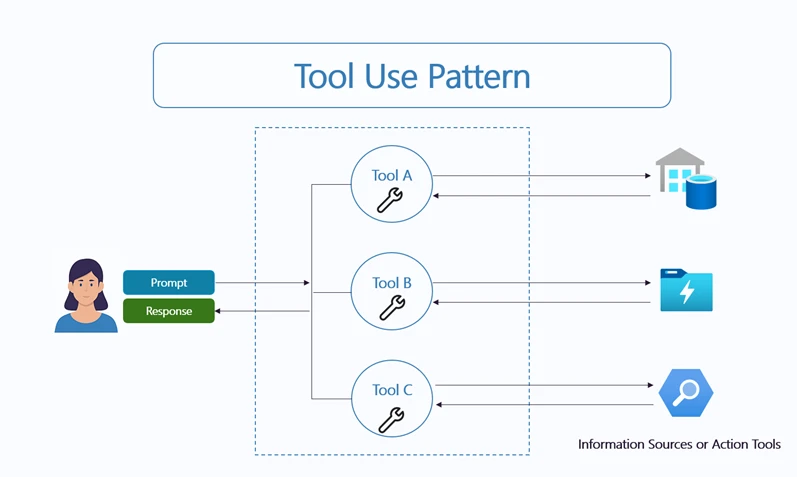
1. Software use sample—from advisor to operator
Fashionable brokers stand out by driving actual outcomes. As we speak’s brokers work together straight with enterprise programs—retrieving knowledge, calling Utility Programming Interface (APIs), triggering workflows, and executing transactions. Brokers now floor solutions and in addition full duties, replace data, and orchestrate workflows end-to-end.
Fujitsu reworked its gross sales proposal course of utilizing specialised brokers for knowledge evaluation, market analysis, and doc creation—every invoking particular APIs and instruments. As an alternative of merely answering “what ought to we pitch,” brokers constructed and assembled complete proposal packages, decreasing manufacturing time by 67%.
2. Reflection sample—self-improvement for reliability
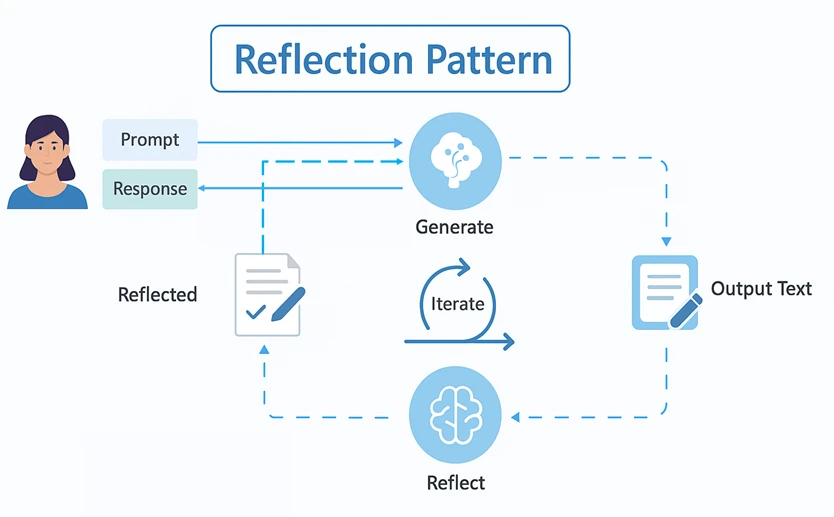
As soon as brokers can act, the subsequent step is reflection—the power to evaluate and enhance their very own outputs. Reflection lets brokers catch errors and iterate for high quality with out at all times relying on people.
In high-stakes fields like compliance and finance, a single error may be pricey. With self-checks and assessment loops, brokers can auto-correct lacking particulars, double-check calculations, or guarantee messages meet requirements. Even code assistants, like GitHub Copilot, depend on inner testing and refinement earlier than sharing outputs. This self-improving loop reduces errors and offers enterprises confidence that AI-driven processes are secure, constant, and auditable.
3. Planning sample—decomposing complexity for robustness
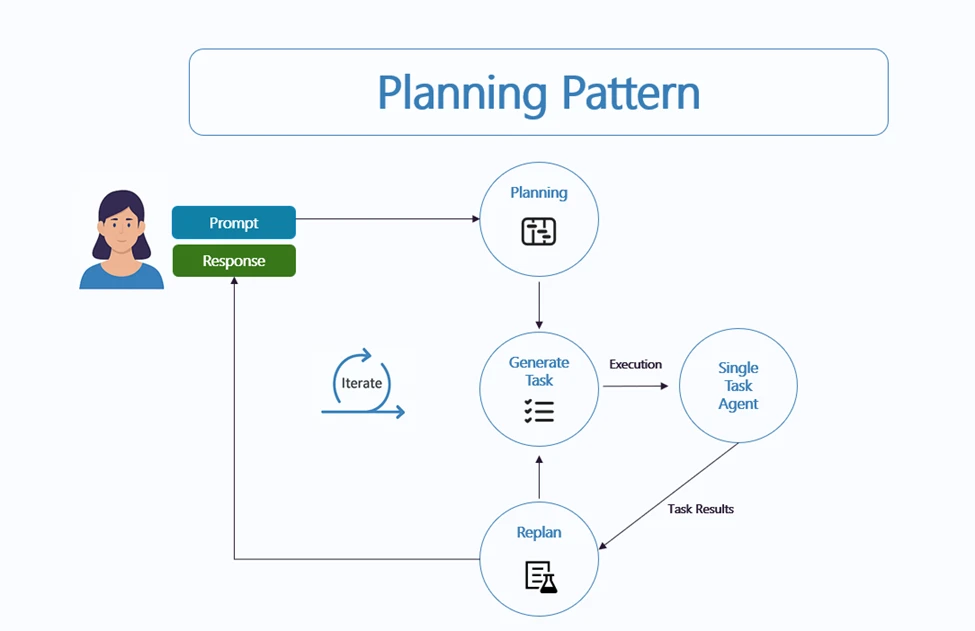
Most actual enterprise processes aren’t single steps—they’re advanced journeys with dependencies and branching paths. Planning brokers handle this by breaking high-level objectives into actionable duties, monitoring progress, and adapting as necessities shift.
ContraForce’s Agentic Safety Supply Platform (ASDP) automated its associate’s safety service supply with safety service brokers utilizing planning brokers that break down incidents into consumption, impression evaluation, playbook execution, and escalation. As every section completes, the agent checks for subsequent steps, making certain nothing will get missed. The outcome: 80% of incident investigation and response is now automated and full incident investigation may be processed for lower than $1 per incident.
Planning typically combines device use and reflection, displaying how these patterns reinforce one another. A key power is flexibility: plans may be generated dynamically by an LLM or comply with a predefined sequence, whichever suits the necessity.
4. Multi-agent sample—collaboration at machine pace
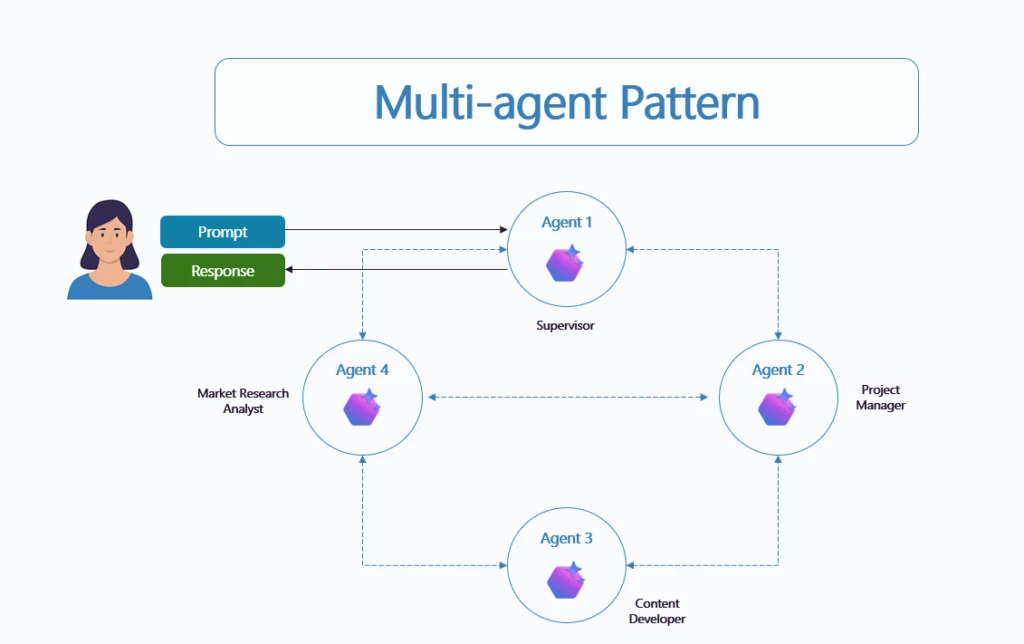
No single agent can do all of it. Enterprises create worth by means of groups of specialists, and the multi-agent sample mirrors this by connecting networks of specialised brokers—every centered on completely different workflow phases—below an orchestrator. This modular design allows agility, scalability, and simple evolution, whereas retaining duties and governance clear.
Fashionable multi-agent options use a number of orchestration patterns—typically together—to deal with actual enterprise wants. These may be LLM-driven or deterministic: sequential orchestration (similar to brokers refine a doc step-by-step), concurrent orchestration (brokers run in parallel and merge outcomes), group chat/maker-checker (brokers debate and validate outputs collectively), dynamic handoff (real-time triage or routing), and magentic orchestration (a supervisor agent coordinates all subtasks till completion).
JM Household adopted this method with enterprise analyst/high quality assurance (BAQA) Genie, deploying brokers for necessities, story writing, coding, documentation, and High quality Assurance (QA). Coordinated by an orchestrator, their improvement cycles turned standardized and automatic—chopping necessities and check design from weeks to days and saving as much as 60% of QA time.
5. ReAct (Purpose + Act) sample—adaptive downside fixing in actual time
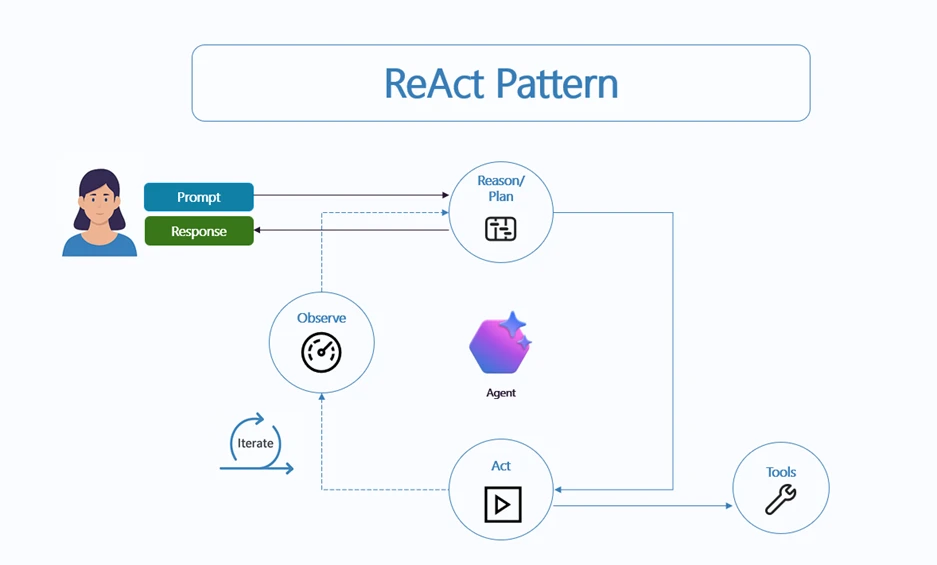
The ReAct sample allows brokers to unravel issues in actual time, particularly when static plans fall quick. As an alternative of a set script, ReAct brokers alternate between reasoning and motion—taking a step, observing outcomes, and deciding what to do subsequent. This permits brokers to adapt to ambiguity, evolving necessities, and conditions the place the perfect path ahead isn’t clear.
For instance, in enterprise IT help, a digital agent powered by the ReAct sample can diagnose points in actual time: it asks clarifying questions, checks system logs, exams doable options, and adjusts its technique as new data turns into obtainable. If the problem grows extra advanced or falls outdoors its scope, the agent can escalate the case to a human specialist with an in depth abstract of what’s been tried.
These patterns are supposed to be mixed. The best agentic options weave collectively device use, reflection, planning, multi-agent collaboration, and adaptive reasoning—enabling automation that’s sooner, smarter, safer, and prepared for the actual world.
Why a unified agent platform is important
Constructing clever brokers goes far past prompting a language mannequin. When transferring from demo to real-world use, groups rapidly encounter challenges:
- How do I chain a number of steps collectively reliably?
- How do I give brokers entry to enterprise knowledge—securely and responsibly?
- How do I monitor, consider, and enhance agent habits?
- How do I guarantee safety and identification throughout completely different agent parts?
- How do I scale from a single agent to a workforce of brokers—or connect with others?
Many groups find yourself constructing customized scaffolding—DIY orchestrators, logging, device managers, and entry controls. This slows time-to-value, creates dangers, and results in fragile options.
That is the place Azure AI Foundry is available in—not simply as a set of instruments, however as a cohesive platform designed to take brokers from concept to enterprise-grade implementation.
Azure AI Foundry: Unified, scalable, and constructed for the actual world
Azure AI Foundry is designed from the bottom up for this new period of agentic automation. Azure AI Foundry delivers a single, end-to-end platform that meets the wants of each builders and enterprises, combining speedy innovation with strong, enterprise-grade controls.
With Azure AI Foundry, groups can:
- Prototype regionally, deploy at scale: Develop and check brokers regionally, then seamlessly transfer to cloud runtime—no rewrites wanted. Take a look at how one can get began with Azure AI Foundry SDK.
- Versatile mannequin selection: Select from Azure OpenAI, xAI Grok, Mistral, Meta, and over 10,000 open-source fashions—all through a unified API. A Mannequin Router and Leaderboard assist choose the optimum mannequin, balancing efficiency, value, and specialization. Take a look at the Azure AI Foundry Fashions catalog.
- Compose modular multi-agent architectures: Join specialised brokers and workflows, reusing patterns throughout groups. Take a look at how one can use linked brokers in Azure AI Foundry Agent Service.
- Combine immediately with enterprise programs: Leverage over 1,400+ built-in connectors for SharePoint, Bing, SaaS, and enterprise apps, with native safety and coverage help. Take a look at what are instruments in Azure AI Foundry Agent Service.
- Allow openness and interoperability: Constructed-in help for open protocols like Agent-to-Agent (A2A) and Mannequin Context Protocol (MCP) lets your brokers work throughout clouds, platforms, and associate ecosystems. Take a look at how to hook up with a Mannequin Context Protocol Server Endpoint in Azure AI Foundry Agent Service.
- Enterprise-grade safety: Each agent will get a managed Entra Agent ID, strong Function-based Entry Management (RBAC), On Behalf Of authentication, and coverage enforcement—making certain solely the correct brokers entry the correct assets. Take a look at how one can use a digital community with the Azure AI Foundry Agent Service.
- Complete observability: Achieve deep visibility with step-level tracing, automated analysis, and Azure Monitor integration—supporting compliance and steady enchancment at scale. Take a look at how one can monitor Azure AI Foundry Agent Service.
Azure AI Foundry isn’t only a toolkit—it’s the muse for orchestrating safe, scalable, and clever brokers throughout the trendy enterprise.
It’s how organizations transfer from siloed automation to true, end-to-end enterprise transformation.
Keep tuned: In upcoming posts in our Agent Manufacturing facility weblog collection, we’ll present you how one can deliver these pillars to life—demonstrating how one can construct safe, orchestrated, and interoperable brokers with Azure AI Foundry, from native improvement to enterprise deployment.