


Find out how the Azure {Hardware} Techniques and Interconnect crew leverages Azure NetApp Recordsdata for chip improvement.
Excessive-performance computing (HPC) workloads place vital calls for on cloud infrastructure, requiring strong and scalable assets to deal with complicated and intensive computational duties. These workloads usually necessitate excessive ranges of parallel processing energy, usually offered by clusters of central processing unit (CPU) or graphics processing unit (GPU)-based digital machines. Moreover, HPC functions demand substantial information storage and quick entry speeds, which exceed the capabilities of conventional cloud file programs. Specialised storage options are required to fulfill the low latency and excessive throughput enter/output (I/O) wants.
Microsoft Azure NetApp Recordsdata is designed to ship low latency, excessive efficiency, and enterprise-grade information administration at scale. Distinctive capabilities of Azure NetApp Recordsdata make it appropriate for a number of high-performance computing workloads corresponding to Digital Design Automation (EDA), Seismic Processing, Reservoir Simulations, and Threat Modeling. This weblog highlights Azure NetApp Recordsdata’ differentiated capabilities for EDA workloads and Microsoft’s silicon design journey.
Infrastructure necessities of EDA workloads
EDA workloads have intensive computational and information processing necessities to handle complicated duties in simulation, bodily design, and verification. Every design stage entails a number of simulations to boost accuracy, enhance reliability, and detect design defects early, lowering debugging and redesigning prices. Silicon improvement engineers can use extra simulations to check totally different design situations and optimize the chip’s Energy, Efficiency, and Space (PPA).
EDA workloads are labeled into two major sorts—Frontend and Backend, every with distinct necessities for the underlying storage and compute infrastructure. Frontend workloads deal with logic design and purposeful elements of chip design and include 1000’s of short-duration parallel jobs with an I/O sample characterised by frequent random reads and writes throughout hundreds of thousands of small recordsdata. Backend workloads deal with translating logic design to bodily design for manufacturing and consists of lots of of jobs involving sequential learn/write of fewer bigger recordsdata.
The selection of a storage resolution to fulfill this distinctive mixture of frontend and backend workload patterns is non-trivial. The SPEC consortium has established the SPEC SFS benchmark to assist with benchmarking the assorted storage options within the business. For EDA workloads, the EDA_BLENDED benchmark gives the attribute patterns of the frontend and backend workloads. The I/O operations composition is described within the following desk.
| EDA workload stage | I/O operation sorts |
| Frontend | Stat (39%), Entry (15%), Learn File (7%), Random Learn (8%), Write File (10%), Random Write (15%), Different Ops (6%) |
| Backend | Learn (50%), Write (50%) |
Azure NetApp Recordsdata helps common volumes which are perfect for workloads like databases and general-purpose file programs. EDA workloads work on giant volumes of information and require very excessive throughput; this requires a number of common volumes. The introduction of huge volumes to help increased portions of information is advantageous for EDA workloads, because it simplifies information administration and delivers superior efficiency in comparison with a number of common volumes.
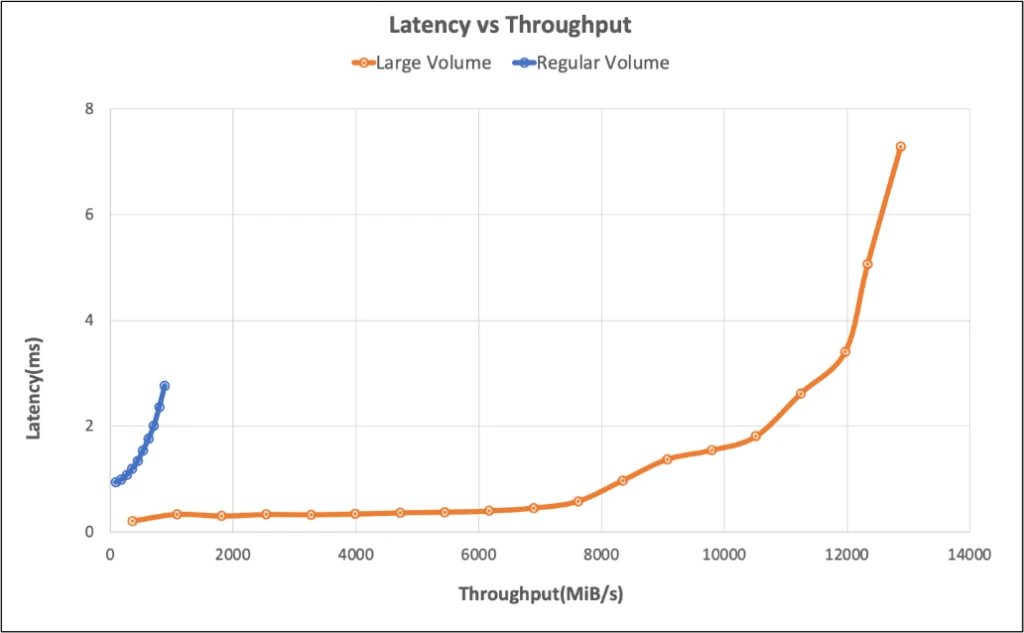
Beneath is the output from the efficiency testing of the SPEC SFS EDA_BLENDED benchmark which demonstrates that Azure NetApp Recordsdata can ship ~10 GiB/s throughput with lower than 2 ms latency utilizing giant volumes.
Digital Design Automation at Microsoft
Microsoft is dedicated to enabling AI on each workload and expertise for gadgets of right this moment and tomorrow. It begins with the design and manufacturing of silicon. Microsoft is surpassing scientific boundaries at an unprecedented tempo for working EDA workflows, pushing the boundaries of Moore’s Legislation by adopting Azure for our personal chip design wants.
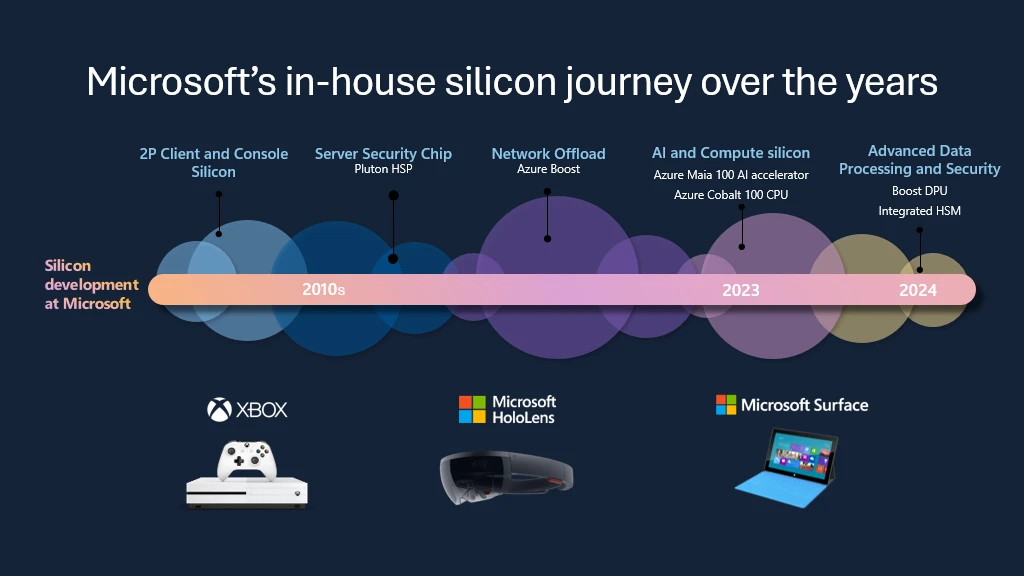
Utilizing the most effective practices mannequin to optimize Azure for chip design between clients, companions, and suppliers has been essential to the event of a few of Microsoft’s first totally customized cloud silicon chips:
- The Azure Maia 100 AI Accelerator, optimized for AI duties and generative AI.
- The Azure Cobalt 100 CPU, an Arm-based processor tailor-made to run common goal compute workloads on Microsoft Azure.
- The Azure Built-in {Hardware} Safety Module; Microsoft’s latest in-house safety chip designed to harden key administration.
- The Azure Increase DPU, the corporate’s first in-house information processing unit designed for data-centric workloads with excessive effectivity and low energy.
The chips developed by the Azure cloud {hardware} crew are deployed in Azure servers delivering best-in-class compute capabilities for HPC workloads and additional speed up the tempo of innovation, reliability, and operational effectivity used to develop Azure’s manufacturing programs. By adopting Azure for EDA, the Azure cloud {hardware} crew enjoys these advantages:
- Fast entry to scalable on-demand innovative processors.
- Dynamic pairing of every EDA software to a particular CPU structure.
- Leveraging Microsoft’s improvements in AI-driven applied sciences for semiconductor workflows.
How Azure NetApp Recordsdata accelerates semiconductor improvement innovation
- Superior efficiency: Azure NetApp Recordsdata can ship as much as 652,260 IOPS with lower than 2 milliseconds of latency, whereas reaching 826,000 IOPS on the efficiency edge (~7 milliseconds of latency).
- Excessive scalability: As EDA tasks advance, information generated can develop exponentially. Azure NetApp Recordsdata gives large-capacity, excessive efficiency single namespaces with giant volumes as much as 2PiB, seamlessly scaling to help compute clusters even as much as 50,000 cores.
- Operational simplicity: Azure NetApp Recordsdata is designed for simplicity, with handy person expertise through the Azure Portal or through automation API.
- Value effectivity: Azure NetApp Recordsdata presents cool entry to transparently transfer cool information blocks to managed Azure storage tier for diminished price, after which routinely again to the new tier on entry. Moreover, Azure NetApp Recordsdata reserved capability gives vital price financial savings in comparison with pay-as-you-go pricing, additional lowering the excessive prices related to enterprise-grade storage options.
- Safety and reliability: Azure NetApp Recordsdata gives enterprise-grade information administration, control-plane, and data-plane safety options, making certain that essential EDA information is protected and accessible with key administration and encryption for information at relaxation and for information in transit.
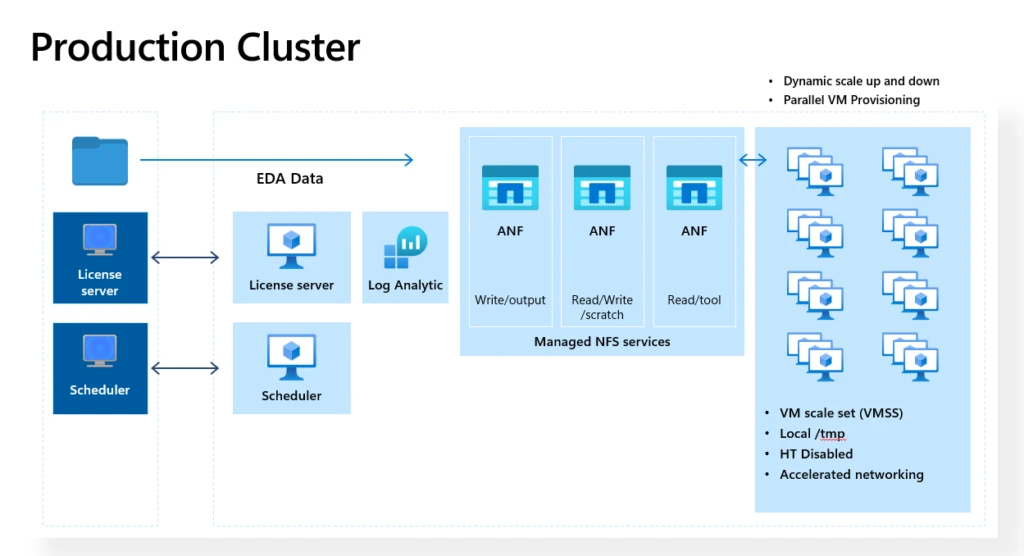
The graphic beneath exhibits a manufacturing EDA cluster deployed in Azure by the Azure cloud {hardware} crew the place Azure NetApp Recordsdata serves purchasers with over 50,000 cores per cluster.
Azure NetApp Recordsdata gives the scalable efficiency and reliability that we have to facilitate seamless integration with Azure for a various set of Digital Design Automation instruments utilized in silicon improvement.
—Mike Lemus, Director, Silicon Growth Compute Options at Microsoft.
In right this moment’s fast-paced world of semiconductor design, Azure NetApp Recordsdata presents agility, efficiency, safety, and stability—the keys to delivering silicon innovation for our Azure cloud.
—Silvian Goldenberg, Accomplice and Common Supervisor for Design Methodology and Silicon Infrastructure at Microsoft.
Study extra about Azure NetApp Recordsdata
Azure NetApp Recordsdata has confirmed to be the storage resolution of selection for probably the most demanding EDA workloads. By offering low latency, excessive throughput, and scalable efficiency, Azure NetApp Recordsdata helps the dynamic and complicated nature of EDA duties, making certain speedy entry to cutting-edge processors and seamless integration with Azure’s HPC resolution stack.
Try Azure Properly-Architected Framework perspective on Azure NetApp Recordsdata for detailed info and steerage.
For additional info associated to Azure NetApp Recordsdata, try the Azure NetApp Recordsdata documentation right here.